
Buying a home in Nebraska involves more than just the purchase price. One important part of the process is understanding closing costs. These are the fees and expenses that must be paid to finalize the mortgage and complete the property transfer.
For many buyers in places like Omaha, Lincoln, and across Nebraska, closing costs can come as a surprise if they are not prepared for them. Understanding what these costs include and how they work can help you budget more confidently as you move toward homeownership.
Understanding Closing Costs for Nebraska Homebuyers
Closing costs are the various fees associated with finalizing a real estate transaction and mortgage loan. These costs are typically paid on the day you officially complete the purchase of the home, which is known as the closing.
Closing costs exist because several professionals and service providers are involved in the home buying process. Lenders, title companies, appraisers, and local government offices all play a role in ensuring the transaction is completed correctly.
In Nebraska, buyers often pay closing costs that range from about 2 percent to 5 percent of the home’s purchase price. However, the exact amount depends on many factors such as the loan program, the property, and the services required for the transaction.
It is important to understand that closing costs vary by lender, loan type, credit profile, and property details. Every mortgage scenario is different, so the final numbers are provided in your official loan documents before closing.
Common Closing Costs Buyers Pay in Nebraska
Several different types of fees make up closing costs. Some are related directly to the mortgage loan, while others cover third party services required to complete the transaction.
Loan Related Fees
Mortgage lenders perform several steps to verify information and prepare the loan for closing.
These costs may include:
-
Mortgage discount fees or rebates depending on the interest rate structure
-
Credit report and other verification services
-
Certain administrative tasks required to process the mortgage
Some lenders charge underwriting or processing fees as part of their loan setup. However, Capital City Mortgage typically does not charge underwriting or processing fees, except for certain specialized loan programs that require them.
These details are clearly outlined in the official loan estimate provided early in the mortgage process.
Third Party Services
Many closing costs are paid to independent service providers involved in the transaction.
Common examples include:
-
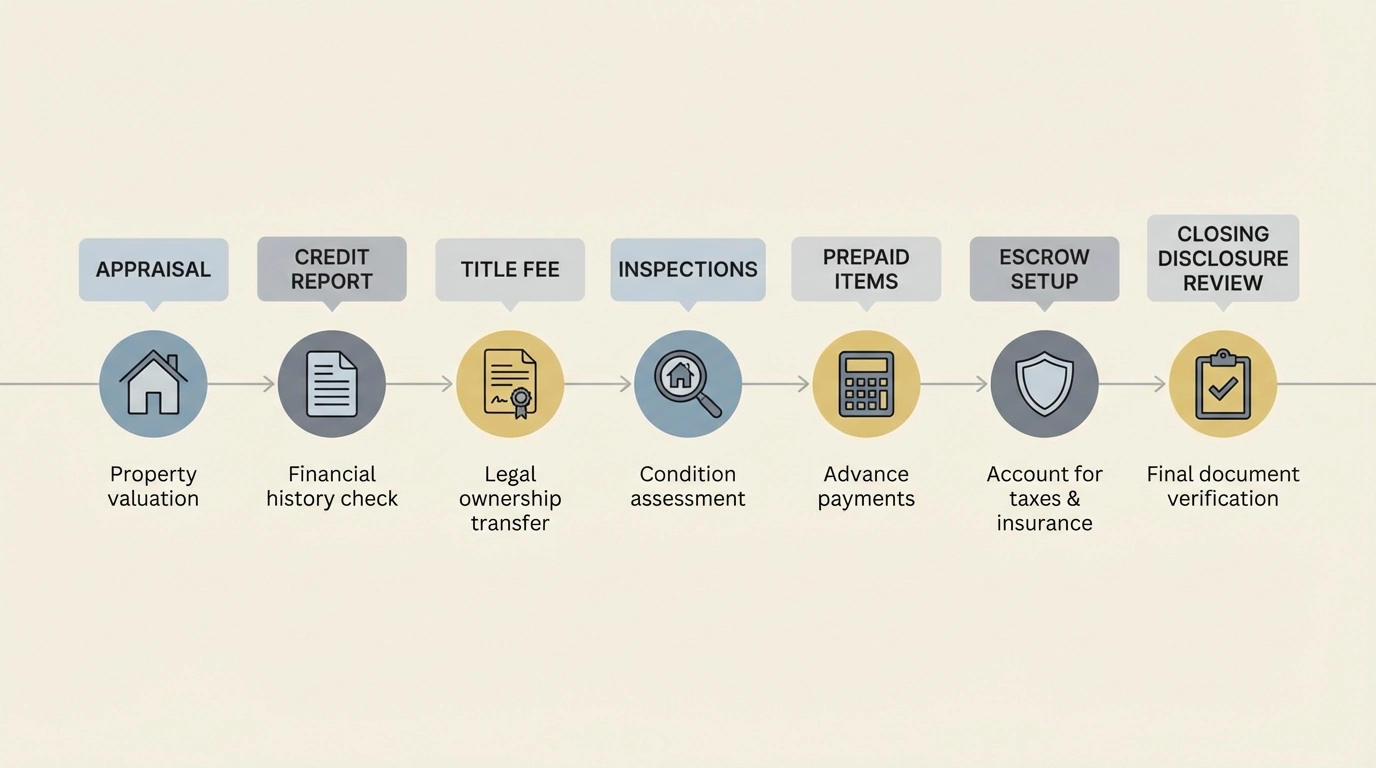
Appraisal fee to determine the home's market value.
-
Home inspections, which is optional but highly recommended for buyers. Common inspections include whole house inspections, pest inspections, roof inspections, and radon inspections.
-
Title search and title services to verify property ownership history.
-
Settlement or escrow services that coordinate the closing process.
- A realtor broker fee is an administrative fee some real estate brokerages charge to cover office overhead, transaction coordination, and compliance costs associated with managing the real estate transaction.
These providers help ensure that the property transfer is accurate and that both the buyer and lender are protected.
Prepaid Costs and Escrows
Not all closing costs are fees. Some are prepaid expenses that set up future payments related to the home.
These often include:
-
Initial property tax escrow deposits. If you purchase a home in Sarpy or Douglas county, there will be additional taxes collected at closing. Expect to pay 8-9 months of taxes at closing.
-
Homeowners insurance premiums. Typically, the first year premium is collected upfront and an escrow account is set up to collect for the next year's premium.
-
Prepaid interest covering the period between closing and the first mortgage payment
These funds help establish the borrower’s escrow account so taxes and insurance can be paid on schedule.
Nebraska Specific Costs Buyers Should Know
Every state has slightly different real estate practices and local costs. Nebraska homebuyers should be aware of a few items that commonly appear in local transactions.
Title Insurance in Nebraska
Title insurance protects against issues that could affect property ownership.
There are usually two policies involved:
-
Lender’s title insurance, which protects the mortgage lender
-
Owner’s title insurance, which protects the buyer’s ownership rights
Title protection helps ensure there are no unresolved claims, liens, or ownership disputes tied to the property.
Property Taxes and Escrow Requirements
Nebraska property taxes are typically higher than the national average compared to home values, which means they can have a meaningful impact on monthly housing costs.
Most borrowers and lenders prefer to collect property taxes through an escrow account, where a portion of the annual tax bill is collected with the monthly mortgage payment.
At closing, buyers usually deposit several months of property taxes into this escrow account to establish the balance.
Recording and Transfer Fees
Local county offices record the property transaction and mortgage documents.
These offices charge small administrative fees for recording the new ownership and lien information in public records. These recording costs are included as part of the final closing expenses.
How Much Are Closing Costs in Lincoln and Omaha?
While closing costs follow similar structures across Nebraska, there can be slight differences between markets such as Lincoln and Omaha.
For example, service pricing for appraisals, title work, or settlement services may vary slightly based on the local market and property type.
As a general illustration:
-
A $250,000 home purchase may have closing costs roughly between $5,000 and $12,500 depending on the loan structure and prepaid items.
-
Higher priced homes may have higher absolute costs because certain services scale with property value.
The exact costs will depend on factors such as:
-
Loan type
-
Down payment
-
Credit profile
-
Property taxes
-
Insurance costs
-
Seller concessions or lender credits
Your lender will provide a Loan Estimate and later a Closing Disclosure outlining these costs before the final closing appointment.
Can Buyers Reduce or Manage Closing Costs?
Many buyers are surprised to learn that closing costs are sometimes flexible within certain guidelines.
Seller Concessions
In some purchase agreements, sellers may agree to contribute toward the buyer’s closing costs.
These contributions are called seller concessions. They are negotiated during the purchase contract and must fall within limits set by the loan program.
Seller credits can help reduce the amount of cash the buyer needs to bring to closing.
Lender Credits
Some mortgage structures allow borrowers to receive lender credits in exchange for accepting a slightly higher interest rate.
These credits can be applied toward closing costs. The trade off should always be evaluated carefully because it affects the long term cost of the loan.
Mortgage rates are based on daily market averages and vary depending on credit profile, loan type, equity position, and overall market conditions. All loans are subject to underwriting approval.
First Time Buyer Programs
Nebraska homebuyers may also qualify for certain first time homebuyer assistance programs.
Some programs offer:
-
Down payment assistance
-
Grants
-
Funds that can help with closing costs
Eligibility varies based on income, location, and program guidelines. For Nebraska, NIFA is the most common state first time home buyer program.
What Buyers Should Review Before Closing Day
Before the closing, buyers receive a document called the Closing Disclosure.
This document provides the final breakdown of:
-
Mortgage terms
-
Interest rate
-
Monthly payment
-
All closing costs and prepaid expenses
Buyers should review this document carefully and ask questions if any fees or numbers appear unclear.
Understanding the details before closing helps ensure a smooth and confident final signing process. Capital City Mortgage will always review this with our clients prior to the closing.
Preparing for Closing Costs When Buying a Home in Nebraska
Closing costs are an important part of the home buying journey. While they may seem complex at first, they are simply the collection of services and prepaid expenses needed to finalize the purchase of your home.
With the right guidance and early planning, buyers in Lincoln, Omaha, and across Nebraska can prepare for these costs and avoid surprises at closing.
At Capital City Mortgage, our goal is to help buyers understand every step of the mortgage process. We provide clear explanations, transparent estimates, and personalized guidance for Nebraska homebuyers.
If you are planning to buy a home, you can apply online today or schedule a free consultation to receive a personalized closing cost estimate based on your goals and situation.
All mortgage loans are subject to credit approval. Terms and program availability may change without notice.
For additional information about closing costs and the home buying process, you can also review helpful resources from the Consumer Financial Protection Bureau:
https://www.consumerfinance.gov/owning-a-home/closing-costs/
The U.S. Department of Housing and Urban Development also provides helpful guidance for homebuyers:
https://www.hud.gov/program_offices/housing/sfh/buying
What are typical closing costs in Nebraska?
Closing costs in Nebraska often range between 2 percent and 5 percent of the home purchase price. The exact amount depends on the loan program, property taxes, insurance costs, and services required for the transaction.
Can closing costs be rolled into a mortgage?
In some cases, refinancing borrowers may be able to include closing costs in the loan balance. For home purchases, closing costs are usually paid at closing unless seller concessions or lender credits help offset the expenses.
Do buyers or sellers pay closing costs in Nebraska?
Both buyers and sellers typically have their own closing costs. Buyers usually pay lender fees, appraisal costs, title services, and prepaid expenses such as taxes and insurance. Sellers often pay real estate commissions and certain title related fees.
When do you pay closing costs when buying a home?
The majority of closing costs are paid on the day the real estate transaction is finalized. Several fees are commonly paid in advance outside of closing. These commonly include the appraisal fee, home inspections, and credit reports.