
A 20% down payment can lower your mortgage payment and remove the need for private mortgage insurance on many conventional loans. That does not mean putting 20% down is always the best financial decision.
Some buyers are better served by putting 5% down and keeping more money available for repairs, moving costs, emergencies, or the sale of another home. Others have enough savings to put 20% down without weakening their cash position.
The right choice depends on the complete mortgage payment, cash remaining after closing, financial goals, and how long you expect to own the property.
You Usually Do Not Need 20% Down
The idea that every buyer needs 20% down keeps some people from purchasing when they may already have enough money to qualify.
Conventional mortgage programs may allow down payments as low as 3% for eligible borrowers. FHA loans may require as little as 3.5%, while eligible VA and USDA borrowers may have zero-down-payment options. Credit, income, property type, occupancy, loan limits, and other requirements still apply.
The Consumer Financial Protection Bureau confirms that low-down-payment options are available, although they can result in higher borrowing costs. The CFPB explains common down-payment options.
A smaller down payment can make homeownership possible sooner. The question is whether the resulting loan and payment fit the household’s budget.
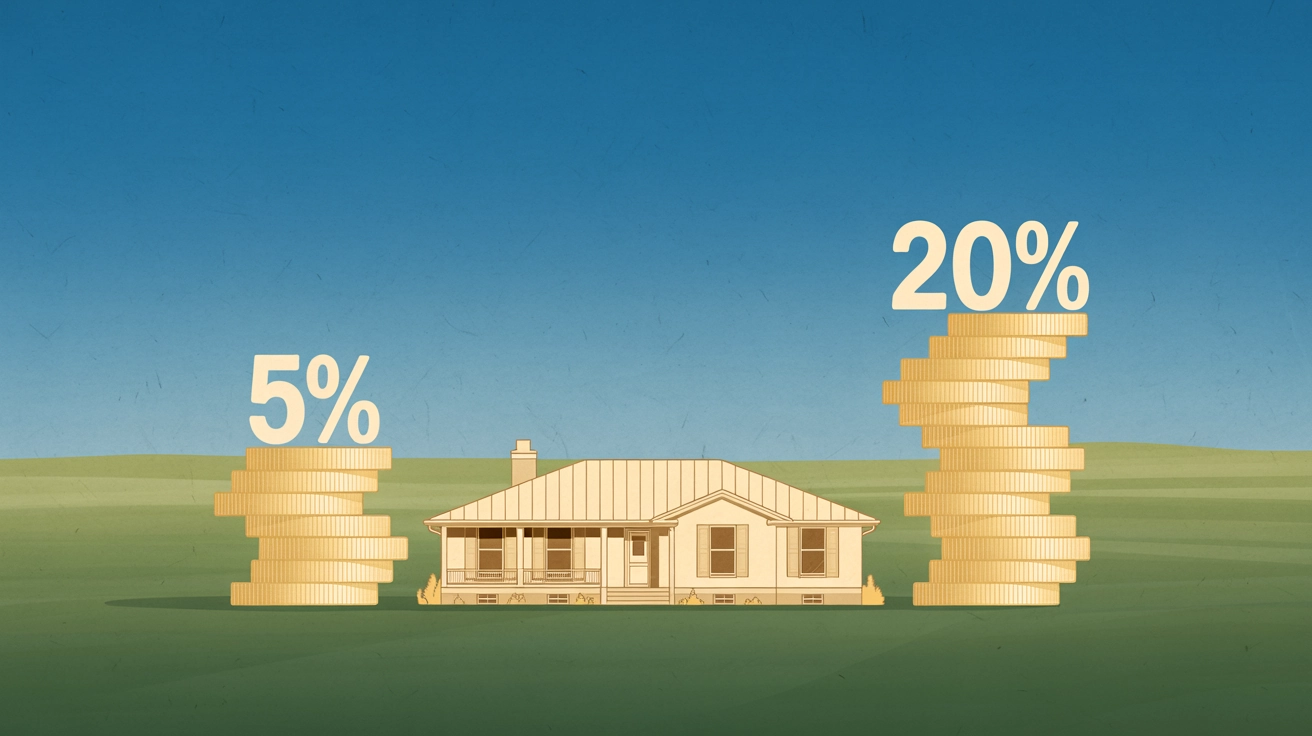
Comparing 5% and 20% Down
Assume a buyer is purchasing a $400,000 home.
A 5% down payment would be $20,000, resulting in a $380,000 loan before any financed mortgage insurance or program-specific charges. A 20% down payment would be $80,000, resulting in a $320,000 loan.
The difference is $60,000 in upfront cash. That is a meaningful amount, but it should not be evaluated by itself.
The 20% option starts with a lower loan balance, creates more immediate equity, and normally produces a lower principal and interest payment. The 5% option allows the buyer to keep that $60,000 available for other needs, but it produces a larger mortgage and will usually require private mortgage insurance on a conventional loan.
Interest rates and mortgage insurance depend on the borrower’s credit, loan program, property, and current pricing. A proper comparison should use written estimates prepared for the same buyer and property.
The Advantages of Putting 20% Down
A larger down payment reduces the amount borrowed. That usually lowers the monthly principal and interest payment and the total interest paid if the mortgage is kept for its full term.
A conventional buyer putting at least 20% down will also generally avoid private mortgage insurance. PMI protects the lender, not the homeowner, and adds to the monthly housing expense. The CFPB notes that conventional borrowers putting down less than 20% will typically need mortgage insurance. Review the CFPB’s conventional mortgage guidance.
Twenty percent down also creates a larger equity cushion. This can provide more flexibility if the owner needs to sell during a weaker housing market or refinance later.
A stronger equity position may improve loan pricing or approval in some situations. However, 20% down does not guarantee approval or the lowest available rate.
The Disadvantages of Putting 20% Down
The main disadvantage is the amount of cash committed to the property. Money used for the down payment becomes home equity and is no longer readily available in a checking or savings account.
A buyer who puts every available dollar into the house may struggle with closing costs, moving expenses, furniture, repairs, or an unexpected income interruption. New homeowners often discover expenses during the first year that were not part of the purchase budget.
Fannie Mae advises buyers to plan for more than the down payment. Closing costs, renovations, repairs, moving expenses, and an emergency fund should also be considered. Fannie Mae outlines the cash needs that extend beyond a down payment.
Putting 20% down may also delay the purchase while the buyer saves more money. During that time, home prices, interest rates, rent, and the buyer’s personal situation can change.
The Advantages of Putting 5% Down
A 5% down payment preserves more cash. That can be valuable for buyers who want a strong emergency fund or expect significant expenses after closing.
It may also help a move-up buyer purchase before receiving proceeds from the sale of the current home. The buyer could keep cash available during the transition and decide later how much of the sale proceeds to apply to the new mortgage.
A smaller down payment may allow someone to buy sooner instead of waiting several years to save 20%. If the payment remains affordable and the buyer has stable income, this can be a reasonable strategy.
Low-down-payment conventional financing is not only for buyers with limited savings. It can also be a deliberate liquidity decision for a household that prefers to keep more cash available.
The Disadvantages of Putting 5% Down
The buyer will borrow more, which increases the principal and interest payment. The larger balance also creates more interest expense if the loan remains open for a long time.
Private mortgage insurance will normally be required on a conventional loan with 5% down. The cost varies based on credit, down payment, loan amount, and other risk factors. It should be included when comparing the complete monthly payment.
PMI is not always permanent. For many qualifying mortgages, a homeowner may request cancellation when the balance is scheduled to reach 80% of the property’s original value and other requirements are met. Automatic termination generally occurs when the balance is scheduled to reach 78%, provided the loan is current. The CFPB explains federal PMI cancellation rules and their limitations.
A 5% down payment also provides less protection if the property value falls or the owner needs to sell shortly after buying. Real estate commissions and other selling expenses can use a large part of the available equity.
Compare Cash After Closing, Not Only Cash to Close
The stronger down-payment decision is often the one that leaves the household financially stable after closing.
Start with the required down payment and closing costs. Then account for moving expenses, immediate repairs, planned improvements, other debts, and a reasonable emergency fund.
For example, a buyer with $95,000 available may be able to put $80,000 down on a $400,000 home. After closing costs and moving expenses, however, that buyer could be left with very little cash. A 10% or 15% down payment might provide a better balance between the mortgage payment and remaining reserves.
There is no rule that says the choice must be exactly 5% or 20%. A middle option may reduce the loan balance and PMI cost while preserving useful savings.
Can You Apply More Money After Closing?
A buyer can normally make an additional principal payment after closing. This reduces the balance and future interest, but it does not automatically lower the required monthly payment.
Some conventional loans may be eligible for a recast. With a recast, the servicer recalculates the payment using the lower balance, existing interest rate, and remaining term. Minimum principal payments, fees, timing, and eligibility vary.
This can be useful for buyers who purchase with a smaller down payment and later receive proceeds from selling another property. The recast option should be confirmed before relying on it.
Who Is Each Strategy Most Relevant For?
A 5% down payment may fit a buyer with stable income who wants to preserve cash, buy sooner, complete repairs, or manage the transition between two homes. The payment, PMI, and remaining reserves still need to be comfortable.
A 20% down payment may fit a buyer who has substantial savings beyond the down payment and closing costs. It can be attractive for someone focused on a lower monthly payment, reduced interest, immediate equity, and avoiding conventional PMI.
The decision should be based on side-by-side numbers. At Capital City Mortgage, we can compare multiple down-payment amounts and lenders while showing the payment, PMI, cash to close, and money remaining after closing. That gives Nebraska buyers a practical way to choose a mortgage structure without draining savings or paying unnecessary costs.
Frequently Asked Questions
Is 20% down required to buy a house?
No. Many conventional and government-backed mortgage programs allow less than 20% down. The minimum depends on the loan program, borrower, property, occupancy, and lender requirements.
Is putting 5% down on a house a bad idea?
No. A 5% down payment can be reasonable when the payment is affordable and it allows the buyer to keep adequate savings. The higher loan balance and mortgage insurance should be included in the comparison.
Does putting 20% down eliminate PMI?
Generally, yes, on a conventional mortgage. Private mortgage insurance is typically not required when the first mortgage begins at 80% or less of the property value. Other loan programs may have different insurance or fee requirements.
Can I make a larger principal payment after buying the home?
Yes. An additional principal payment can reduce the balance and future interest, but it does not automatically lower the required payment. An eligible loan may be recast if the servicer allows it.