
Waiting for a lower mortgage rate sounds reasonable. A lower rate can reduce
A fixed-rate mortgage keeps the interest rate from changing during the loan term. It does not guarantee that the total amount withdrawn from your bank account will remain the same.
Most mortgage payments include more than principal and interest. Property taxes, homeowners insurance, mortgage insurance, and an escrow shortage can also affect the total payment. When homeowners ask why a fixed-rate payment increased, the escrow account is often the reason.
What Stays Fixed on a Fixed-Rate Mortgage?
With a standard fixed-rate mortgage, the scheduled principal and interest payment normally stays the same. The principal portion gradually increases while the interest portion decreases, but the combined amount follows the loan’s amortization schedule.
Your total mortgage payment may include several additional expenses. The Consumer Financial Protection Bureau explains that a total payment commonly includes principal, interest, property taxes, homeowners insurance, and mortgage insurance.
Property taxes and insurance are not controlled by the mortgage rate. When either expense changes, the total payment can change even though the loan’s interest rate remains fixed.
How Does a Mortgage Escrow Account Work?
An escrow account is used to collect money for certain property-related expenses. The mortgage servicer adds part of the estimated annual cost to each monthly payment, holds that money in the account, and pays the bills when they become due.
For example, assume the expected property taxes and homeowners insurance total $6,000 per year. The servicer may collect about $500 per month for those expenses, plus any permitted cushion or shortage repayment.
Escrow makes large bills easier to budget for because the cost is divided among monthly payments. The CFPB’s escrow account explanation also notes that the amount can change as property taxes and insurance premiums change.
Why Did the Escrow Portion Increase?
Property Taxes Changed
Property taxes can increase after a new assessment, a change in the local tax levy, the expiration of an exemption, or the completion of new construction. The timing varies by county and property.
A new-construction buyer deserves extra attention. The taxes available when the mortgage closes may reflect only the lot or an incomplete home. When the county later assesses the completed property, the tax bill can rise substantially.
Nebraska also pays real estate taxes in arrears, which can make the timing confusing. Homeowners should read assessment notices carefully and review the county’s current property record when estimating future expenses.
Homeowners Insurance Premiums Increased
Homeowners insurance can change at renewal because of construction costs, claims history, roof age, coverage changes, deductibles, and broader insurance-market conditions. The mortgage servicer does not set the premium.
If an annual premium rises from $1,800 to $2,400, the escrow account must collect about $50 more each month for the future bill. The payment could increase further if the higher premium also created an escrow shortage.
Review the policy rather than focusing only on price. A cheaper policy may carry a larger deductible, lower coverage limits, or less protection for the home.
An Escrow Shortage Was Found
A shortage means the account is projected to have less money than required to pay the expected bills while maintaining the permitted balance. This commonly happens when taxes or insurance cost more than the prior estimate.
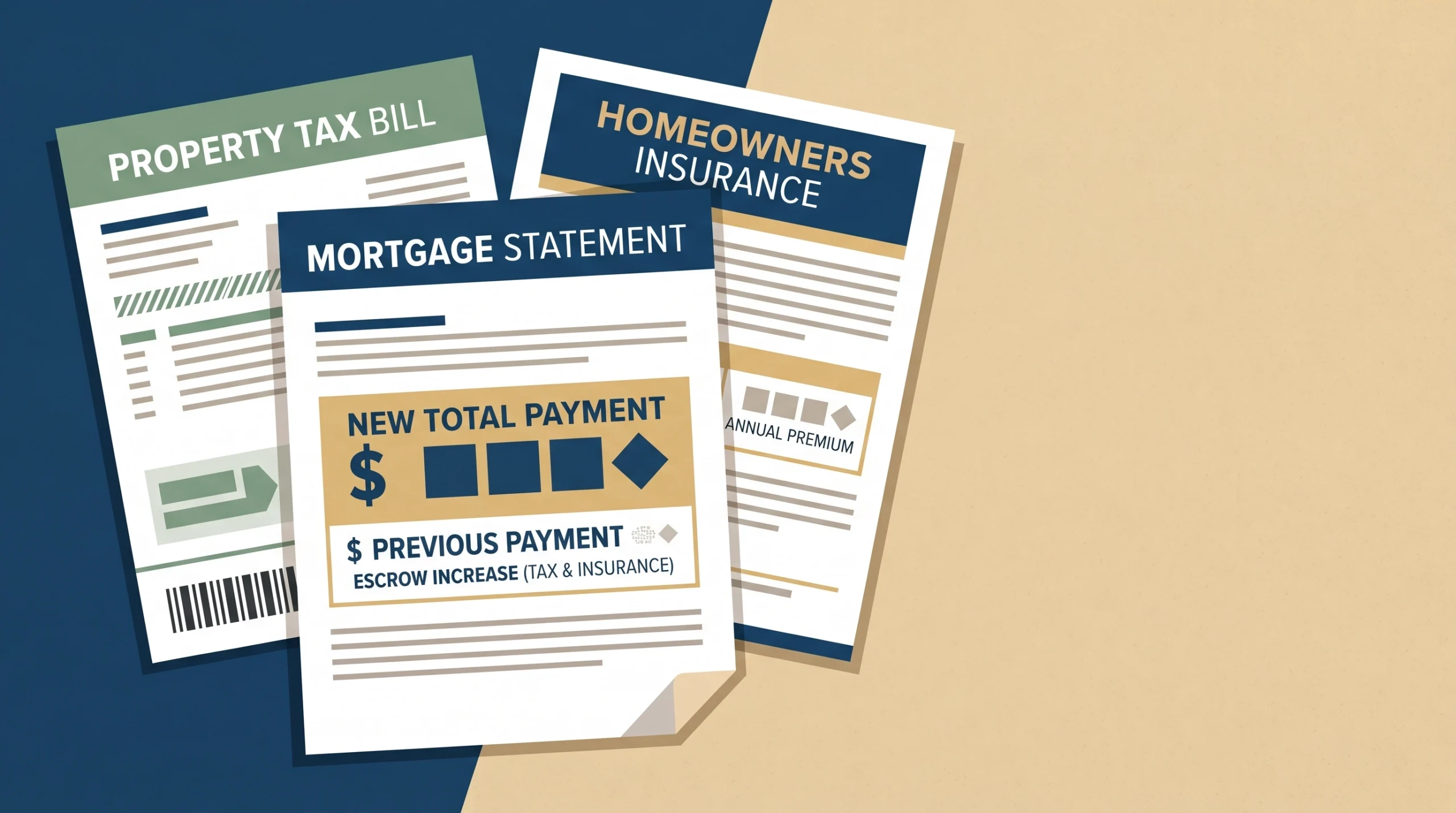
A shortage can cause two increases at the same time. The servicer begins collecting more for next year’s higher bills, and it may add a separate amount to repay the shortage from the prior year.
Suppose taxes and insurance increased by $1,200 per year, adding $100 to the normal monthly escrow deposit. If the account also has a $1,200 shortage spread across 12 months, the total payment could temporarily rise by about $200 per month. After the shortage is repaid, part of that increase may end, but the higher tax and insurance collection could remain.
What Is an Annual Escrow Analysis?
Mortgage servicers generally review escrow accounts each year. The analysis compares the money collected with the bills paid and projects the amount needed for the next escrow year.
The statement should show the prior account activity, projected bills, new monthly escrow amount, and any shortage or surplus. Federal servicing rules require the servicer to perform an analysis before providing the annual statement. The CFPB provides a more detailed description of annual escrow account statements.
Do not assume that every payment increase is correct. Compare the tax and insurance amounts on the statement with the actual county bill and insurance renewal. Contact the servicer if an amount appears duplicated, outdated, or inaccurate.
What Can You Do About an Escrow Shortage?
Start by identifying whether the change came from taxes, insurance, the shortage, or a combination of those items. Your annual statement should separate them.
Servicers may spread an eligible shortage across at least 12 months under federal rules. The exact options depend on the shortage amount, payment status, mortgage documents, and servicing requirements. The CFPB’s federal escrow rules explain how shortages, deficiencies, and surpluses are handled.
Some servicers may allow a voluntary lump-sum payment in certain situations, but paying the shortage does not reverse the underlying increase in taxes or insurance. It only removes or reduces the shortage repayment portion.
If the payment creates a budget problem, contact the servicer promptly. Do not send a different amount without confirming how it will be applied.
What Happens if There Is an Escrow Surplus?
A surplus occurs when the escrow account contains more money than the permitted amount needed for projected bills and the allowed cushion.
Under federal rules, a servicer generally must refund an escrow surplus of at least $50 within 30 days of the analysis when the borrower is current. A surplus below $50 may be refunded or credited toward future escrow payments.
A refund is not always extra spending money. Check whether the next year’s tax or insurance estimate is accurate before using it. An underestimated future bill could create another shortage later.
Can You Remove the Escrow Account?
Some conventional mortgages may allow an escrow waiver when the borrower meets the lender, investor, equity, credit, and payment-history requirements. A fee or pricing adjustment may apply. Government-backed programs and certain higher-priced mortgages can have different requirements.
Removing escrow does not eliminate property taxes or insurance. It transfers responsibility for budgeting and paying those expenses directly to the homeowner.
The benefit is greater control over the money and payment timing. The disadvantage is having to save for large bills and monitor due dates. Missing a property-tax or insurance payment can lead to penalties, a tax lien, lost coverage, or lender-purchased insurance.
Could Something Other Than Escrow Change the Payment?
Escrow is common, but it is not the only possible reason. An adjustable-rate mortgage can change after its fixed period. A temporary buydown can also produce scheduled payment increases during its first few years.
Mortgage insurance may end, change, or be recalculated depending on the loan type and applicable rules. Fees, delinquent amounts, or changes following a loan modification can also affect the amount due.
The CFPB maintains a useful overview of common reasons a monthly mortgage payment changes. Your mortgage statement and escrow analysis should identify the specific reason for your loan.
Who Should Review Their Escrow Account Closely?
An escrow review is especially important for buyers of new construction, homeowners who received a new property valuation, and anyone whose insurance premium recently increased. It is also helpful after changing insurance companies, completing a major addition, or losing a property-tax exemption.
Homeowners should compare the annual analysis with the actual bills, keep assessment and insurance notices, and update automatic payments after the required mortgage payment changes.
Understand the Complete Mortgage Payment
A fixed mortgage rate protects the principal and interest payment from market-rate changes. It does not freeze property taxes, insurance premiums, or the escrow account.
At Capital City Mortgage, we help Nebraska buyers estimate the complete payment before purchasing, including realistic taxes and insurance. We also explain how new construction, mortgage insurance, and escrow can affect future payments so borrowers know what to expect after closing.
the monthly payment and the amount of interest paid over time. The problem is that no one knows when rates will fall, how far they might fall, or what home prices will be when they do.
Rates could be lower in two years, three years, or two weeks. They could also rise or stay near the same level. Instead of building your home purchase around one prediction, consider what would happen under all three possible rate directions.
Start With the Payment You Can Afford Today
The first question should not be where rates might go. It should be whether you can comfortably afford the home and mortgage available today.
Review the full payment, including principal, interest, property taxes, homeowners insurance, mortgage insurance, and association dues when applicable. The Consumer Financial Protection Bureau recommends using a realistic interest rate and complete housing payment when setting a homebuying budget.
A future refinance should never be required to make the current payment affordable. Refinancing may become available later, but it is not guaranteed. If today’s payment would stretch the budget too far, waiting and improving your finances may be the better choice.
If the payment is comfortable and you expect to own the home long enough for the purchase to make sense, consider the three directions rates could take.
Scenario 1: Mortgage Rates Go Up
If mortgage rates rise after you buy, purchasing at today’s rate may look like the better decision. You would have secured financing before borrowing became more expensive.
Higher rates can reduce demand because fewer buyers can qualify for the same price. That may slow home-price growth or give buyers more negotiating power. However, lower demand does not guarantee that prices will fall enough to offset the higher mortgage payment.
Assume you wait for a better rate, but rates move higher instead. You may need to lower your price range, increase the down payment, or accept a larger monthly payment. You might also spend another year paying rent without building equity in a property.
Buying before rates rise removes that future rate risk if you use a fixed-rate mortgage. Your principal and interest payment remains scheduled according to the loan terms, although taxes, insurance, and other housing expenses can still change.
Scenario 2: Mortgage Rates Stay Near the Same Level
Rates do not always make a large move. They can remain within a general range for months or fluctuate without creating a meaningful long-term change.
If rates are similar next year, waiting may not provide the payment improvement you expected. Meanwhile, the home you want could cost more. Home prices do not rise every year or in every area, but long-term price trends can make waiting more expensive when demand remains steady and housing supply is limited.
For example, a buyer who waits for a lower rate may find that rates are nearly unchanged while a $325,000 home now costs $335,000. That buyer may need more money for the down payment and could borrow more even though the rate did not improve.
The opposite is also possible. Prices could remain flat or decline. The point is not that homes always appreciate. It is that waiting for rates also means accepting uncertainty about prices, inventory, rent, and competition.
The Federal Housing Finance Agency House Price Index tracks changes in home values across the country. Historical data can show past cycles, but it cannot tell an individual buyer what a specific Nebraska property will be worth in the future.
Scenario 3: Mortgage Rates Go Down
If rates fall after you purchase, you may be able to refinance. This could reduce the monthly payment, shorten the mortgage term, or change the loan structure.
Buying now may also let you purchase at today’s home price and begin building equity through principal payments. The property could appreciate, although appreciation is never guaranteed. If home prices rise while rates fall, the buyer who waited could receive a lower rate but pay more for the house.
There may also be more competition when rates decline. Lower payments can bring additional buyers into the market. Popular properties may receive more offers, sellers may become less willing to negotiate, and prices may respond to stronger demand.
This creates an important distinction. You may be able to refinance a mortgage rate, but you cannot refinance the original purchase price. That does not mean buying now is always better. It means both the rate and the price should be considered.
Do Not Assume You Will Be Able to Refinance
“Buy now and refinance later” and “Date the rate and marry the house” should be treated as an opportunity, not a promise. A refinance creates a new mortgage, and eligibility depends on the loan program and your circumstances at that time.
For a standard refinance, the lender may review your income, employment, credit, debts, property value, equity, and payment history again. A drop in rates does not guarantee that you will qualify or that the savings will be large enough to support the cost.
Government-backed loans may offer streamlined refinance options. FHA borrowers may qualify for an FHA Streamline Refinance. Eligible VA borrowers may use a VA Interest Rate Reduction Refinance Loan, commonly called an IRRRL. USDA borrowers may have access to one of USDA’s streamlined refinance programs.
These programs can require less documentation and may not require a traditional appraisal, depending on the program and transaction. However, they still have eligibility rules. The existing mortgage generally must be the same type of government-backed loan, the borrower must meet applicable payment-history requirements, and the refinance must provide the required financial benefit. Costs, seasoning periods, occupancy rules, and lender requirements may also apply.
A streamline refinance does not mean the transaction is automatic or free. Closing costs and fees may still apply, and borrowers must qualify under the current program rules. The CFPB explains that a refinance replaces the existing mortgage with a new loan and that borrowers should determine whether the lower payment comes from the rate, a longer term, or both.
Before refinancing, compare the cost with the monthly savings. If the refinance costs $4,000 and saves $160 per month, the simple break-even period would be 25 months. The homeowner would generally need to keep the new loan beyond that point to recover the cost through monthly savings.
What History Can and Cannot Tell Us
Past mortgage cycles show that rates rise, fall, and spend long periods moving within a range. They can also move quickly when inflation expectations, Federal Reserve policy, employment data, or bond-market conditions change.
The CFPB’s research on the effects of changing mortgage rates shows how a large rate increase can reduce affordability and change housing supply. However, knowing what happened in a prior cycle does not reveal the timing of the next move.
A rate forecast can be useful background information. It should not be the only reason to buy or wait.
Pros and Cons of Buying Before Rates Fall
Buying now can secure today’s home price and current financing terms. It may allow you to stop renting, begin paying down principal, and purchase before lower rates bring more buyers into the market. If rates fall enough later, refinancing may provide another opportunity.
The main risk is that the current payment could be higher than you want. Home values could also fall, and a future refinance might not be available or worthwhile. Buying and refinancing both involve transaction costs, so a short ownership period can make the strategy less attractive.
Waiting can provide time to save more, reduce debt, improve credit, or build a stronger emergency fund. It can also help if your job, household size, or preferred location is likely to change soon. The tradeoff is that rates or prices may move against you while you wait.
Who Should Consider Buying Now?
Buying now may make sense when the payment is comfortable, your income is stable, you have enough money for closing and reserves, and you expect to stay in the home for several years. It is also important to find a property that fits your needs instead of buying solely because you are worried about future rates.
Waiting may be smarter when the payment depends on a future refinance, your savings would be nearly depleted, your employment is uncertain, or you expect to move soon. Improving credit or reducing monthly debt may create a larger benefit than trying to predict the market.
Make the Decision Using Today’s Numbers
There is no crystal ball for mortgage rates. If rates rise, buying today may look favorable. If rates remain similar, waiting may not improve the payment and the home could cost more. If rates fall, a qualified homeowner may have an opportunity to refinance after purchasing at today’s price.
The safest approach is to buy only when the current payment works without depending on appreciation or refinancing. Then treat any future rate improvement as a possible benefit.
At Capital City Mortgage, we help Nebraska buyers compare payments, cash needed, loan options, and realistic rate scenarios before making an offer. We work with multiple lenders, prepare thorough preapprovals, and explain the numbers clearly so you can make a decision based on your finances rather than a market prediction.
Frequently Asked Questions
Why did my mortgage payment increase if I have a fixed interest rate?
A fixed rate normally keeps the scheduled principal and interest payment unchanged. Your total payment can still increase when property taxes, homeowners insurance, mortgage insurance, or an escrow shortage changes.
What is an escrow shortage?
An escrow shortage means the account is projected to have less money than required to pay expected property taxes, insurance, and other escrowed expenses while maintaining the permitted balance.
Will my payment go back down after an escrow shortage is paid?
The shortage repayment portion may end after the shortage is satisfied. However, the payment may remain higher if property taxes or homeowners insurance increased and the account must continue collecting more for future bills.
Can I pay my property taxes and insurance without an escrow account?
Possibly, depending on the loan type and lender or investor requirements. An escrow waiver may require sufficient equity, acceptable credit and payment history, and possibly a fee or pricing adjustment.