
Many homebuyers hear that the Federal Reserve may lower interest rates and assume mortgage rates will fall immediately. That sounds reasonable, but fixed mortgage rates do not work that way.
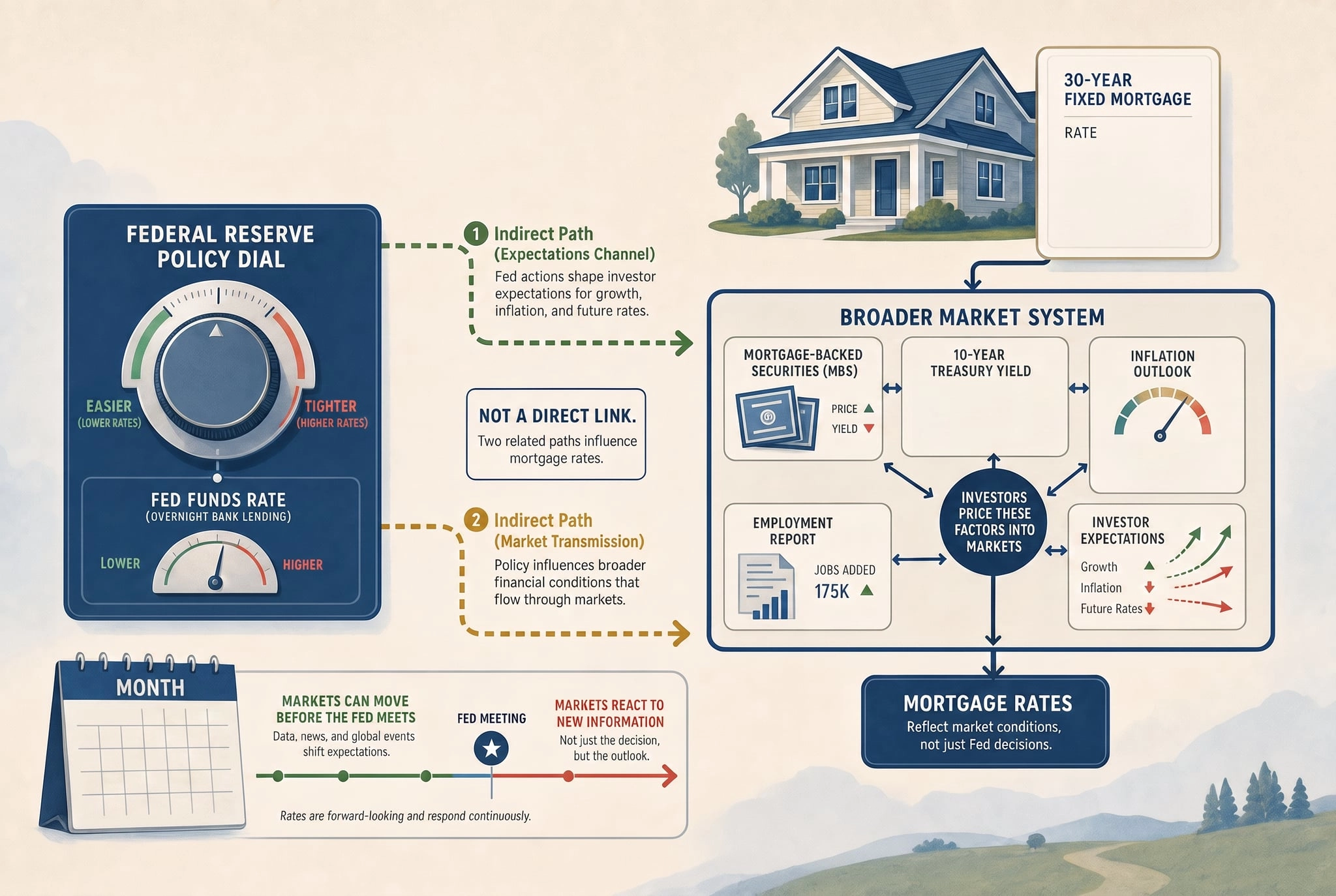
The Federal Reserve directly influences a very short-term interest rate used by banks. Mortgage rates are based more on longer-term bond markets, inflation expectations, economic data, and investor demand for mortgage-backed securities.
Fed decisions still matter. The connection is indirect, and the mortgage market often moves before the Federal Reserve makes an announcement.
What Rate Does the Federal Reserve Control?
The Federal Reserve sets a target range for the federal funds rate. This is the rate banks use when lending reserve balances to each other overnight. It is not a consumer mortgage rate.
At its July 29, 2026 meeting, the Federal Open Market Committee kept the target range at 3.5% to 3.75%. The Federal Reserve’s July 29 statement provides the current policy decision and target range.
Changes to the federal funds rate can influence other borrowing costs. Credit cards, home-equity lines of credit, business loans, and some adjustable-rate products may react more directly because they are tied to short-term benchmarks or the prime rate.
A 30-year fixed mortgage is different. A lender is committing money for a much longer period, even though the loan may be paid off or refinanced before the full 30 years.
What Actually Drives Fixed Mortgage Rates?
Most fixed mortgages are packaged into mortgage-backed securities and sold to investors. The prices investors are willing to pay for those securities help determine the rates lenders can offer.
Mortgage rates are also influenced by longer-term Treasury yields. The 10-year Treasury yield is commonly watched because it often moves in the same general direction as 30-year mortgage rates. The two do not move point for point, and the difference between them can expand or shrink.
Inflation is one of the largest factors. Investors lending money for many years want protection against future dollars losing purchasing power. Higher inflation or stronger inflation expectations can push bond yields and mortgage rates higher.
Employment reports, wage growth, consumer spending, economic growth, government borrowing, geopolitical risk, and investor demand can also move the market. A single important report can affect mortgage pricing more than a widely expected Federal Reserve announcement.
Mortgage Rates Often Move Before the Fed Acts
Financial markets constantly estimate what the Federal Reserve is likely to do next. If investors become confident that the Fed will cut its rate, bond prices and mortgage rates may adjust weeks or months before the actual meeting.
This is why waiting for a Fed rate cut does not guarantee a better mortgage rate afterward. The expected cut may already be included in current pricing.
The opposite can also happen. Mortgage rates may decline before a meeting and then rise after the Fed announces a cut. If the Fed’s comments suggest that inflation remains a concern or future cuts will be slower than expected, longer-term bond yields can increase.
Mortgage News Daily has explained that mortgage rates tend to follow expectations about Fed policy rather than waiting for the federal funds rate itself to change. Its market commentary explains the difference between Fed actions and mortgage-rate movement.
A Current Example of the Difference
The Federal Reserve held its target rate steady on July 29, 2026. Mortgage rates continued moving with the bond market after that meeting.
On August 6, Mortgage News Daily’s national 30-year fixed index was 6.77%, up from 6.75% the prior day. The increase occurred without a new Fed rate increase. Mortgage News Daily publishes its national mortgage-rate index each business day.
That index is a useful market benchmark, not a rate quote for every borrower. An individual rate will depend on credit score, loan type, down payment or equity, property, occupancy, loan size, lock period, points, and lender pricing.
The example shows why borrowers should not treat the federal funds rate and mortgage rates as the same number.
Why Rates Can Change During the Day
Mortgage lenders price loans using current bond-market conditions. When mortgage-backed securities move sharply, lenders may update their rate sheets during the day.
Strong economic data can cause investors to expect higher inflation or fewer Fed cuts. That can push mortgage rates upward. Weaker data or lower inflation readings may have the opposite effect.
Markets can also react differently depending on what investors expected. A strong employment report may have little effect if it matches forecasts. A smaller surprise can create a larger move when investors were positioned for a different result.
This is why rate forecasts are uncertain. Even an informed prediction can be changed quickly by new information.
Should You Wait for a Fed Meeting Before Locking?
Waiting can work when market conditions improve, but it also creates risk. A borrower should not assume that a scheduled Fed meeting will produce a lower rate.
The potential advantage of waiting is that favorable economic data or Fed guidance could improve pricing. The disadvantage is that rates could rise, reducing buying power or increasing the payment shortly before closing.
Consider a $350,000 mortgage. A rate increase of 0.25 percentage points would raise the principal and interest payment by roughly $58 per month on a 30-year loan. This is an illustration and does not include taxes, insurance, mortgage insurance, or loan costs.
The right lock decision depends on the closing date, budget, available rate options, cost of an extension, and ability to accept a higher payment. Buyers close to their maximum comfortable payment may have less reason to gamble on a future improvement.
Rate and Cost Should Be Reviewed Together
The lowest advertised rate may require discount points. Another option may have a slightly higher rate with a lender credit that reduces closing costs.
A buyer expecting to keep the mortgage for many years may benefit from paying a reasonable cost for a lower rate. Someone planning to sell or refinance sooner may prefer lower upfront costs, even with a higher payment.
The Consumer Financial Protection Bureau explains that points lower the rate in exchange for more money at closing, while lender credits reduce upfront costs in exchange for a higher rate. The CFPB outlines how to compare points and lender credits.
A proper comparison should include the rate, annual percentage rate, points, lender credits, payment, cash to close, and expected time in the loan.
Who Should Pay the Most Attention to Fed News?
Homebuyers under contract should watch mortgage pricing, but their closing deadline and budget are more important than trying to predict one Fed meeting. A dependable closing may be worth more than the possibility of a small rate improvement.
Homeowners considering a refinance should calculate the payment savings and break-even period. A Fed cut does not automatically create enough savings to cover closing costs.
Borrowers with a HELOC or certain adjustable-rate loans may see a more direct connection to short-term rates. They should review the index, margin, adjustment schedule, caps, and loan documents to understand when their payment could change.
Real estate and financial professionals can use Fed news as useful background. They should avoid telling clients that a rate cut guarantees lower fixed mortgage rates.
Focus on the Mortgage Market, Not One Headline
Federal Reserve decisions affect the economy and influence mortgage markets, but the Fed does not set the rate on a 30-year fixed loan. Mortgage rates may fall before a Fed cut, remain unchanged afterward, or rise when investors receive new information.
At Capital City Mortgage, we monitor daily mortgage pricing and compare options from multiple lenders. We help Nebraska buyers and homeowners understand the cost of locking, floating, paying points, or using lender credits without relying on a single headline.
The best decision is based on the available loan today, the borrower’s timeline, and the financial effect if the market moves in either direction.
Frequently Asked Questions
Does the Federal Reserve set mortgage rates?
No. The Federal Reserve sets a target for the overnight federal funds rate. Fixed mortgage rates are determined through longer-term bond markets, mortgage-backed securities, inflation expectations, economic data, and lender pricing.
Can mortgage rates rise after the Fed cuts rates?
Yes. Mortgage rates can rise after a Fed cut if the reduction was already expected or if new information causes investors to expect higher inflation, stronger economic growth, or fewer future cuts.
Should I wait for the next Fed meeting before locking my mortgage rate?
Not automatically. Waiting could produce a better rate, but it could also increase the payment or create a closing risk. The decision should consider your closing date, budget, lock options, and ability to accept a higher rate.
What market indicators are most useful for following mortgage rates?
Mortgage-backed securities and longer-term Treasury yields can provide useful direction. Inflation, employment, economic growth, and investor expectations also matter, but none of these indicators can predict an individual mortgage rate with certainty.