
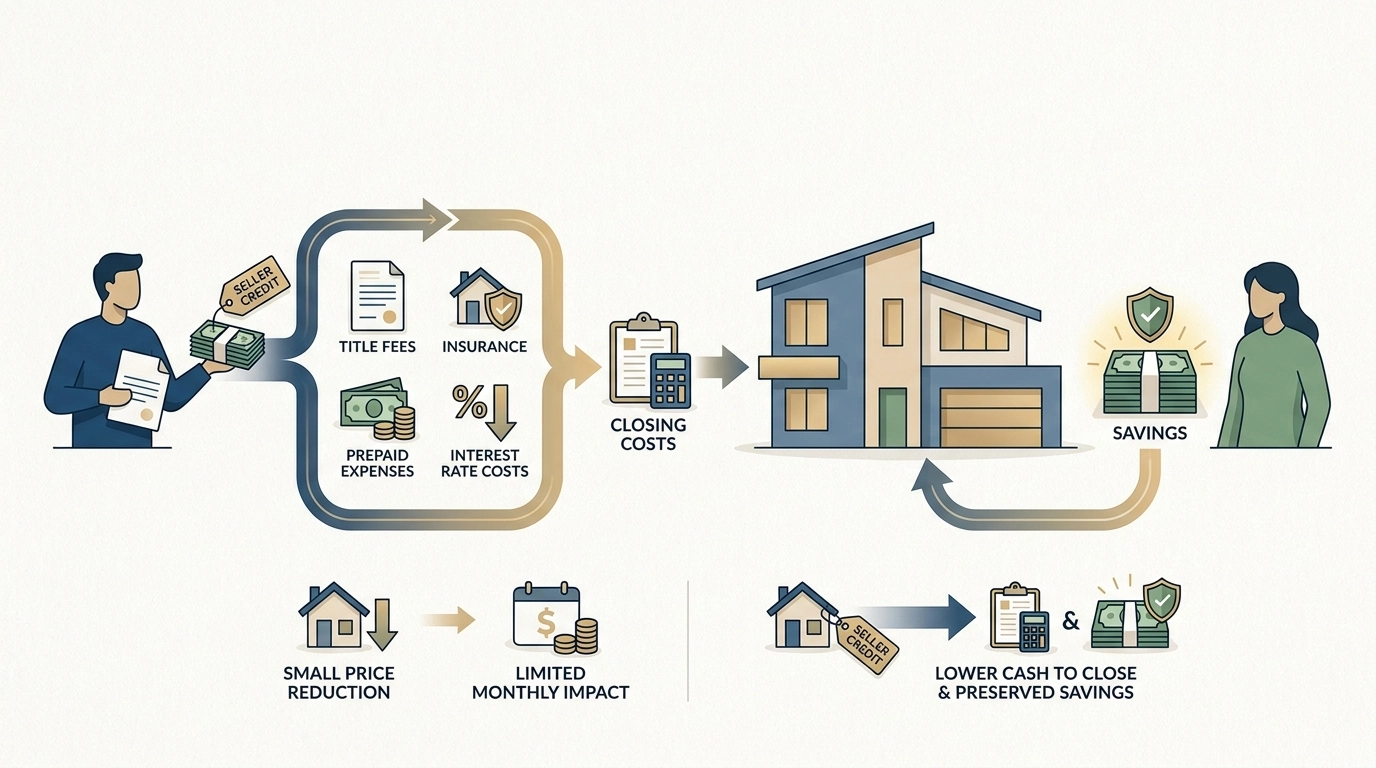
Seller credits can be a really helpful part of buying a home. They can lower the amount of cash you need at closing, and they can also help pay for closing costs, prepaid expenses, and sometimes even lowering your mortgage rate.
The key thing is knowing what seller credits can and can't do. A seller credit is not the same thing as lowering the price of the home, and it's also not cash you get to keep after closing. The credit has to be set up the right way and follow the rules for your loan program.
What Is a Seller Credit?
A seller credit is money the seller agrees to put toward certain costs for the buyer. You might also hear it called a seller concession or interested party contribution. The exact name can change depending on the loan program, but the idea stays the same: the seller agrees to pay some of the buyer's costs instead of keeping the full sale price.
For example, say a buyer agrees to buy a home for $350,000 with a $7,000 seller credit. The price of the home is still $350,000. The credit doesn't lower the loan amount dollar for dollar. Instead, it helps pay costs the buyer would normally have to cover, which can lower how much cash the buyer needs at closing.
What Can Seller Credits Be Used For?
Seller credits are usually used for normal closing costs and prepaid expenses. Depending on the loan and the deal, this can include things like:
-
Loan costs
-
Discount points
-
Title charges
-
Prepaid interest
-
Initial escrow deposits
-
Homeowners insurance costs
-
Other allowable closing expenses
Fannie Mae allows credits to go toward closing costs and prepaid items, as long as they follow its limits and rules, and FHA also allows credits toward certain costs under its own rules. You should figure out exactly how the credit can be used before writing up the purchase agreement, since a big seller credit doesn't help much if you don't have enough eligible costs to use it on.
Seller Credits Usually Can't Replace Your Down Payment
This is one of the biggest misunderstandings people have. A seller credit usually can't be used to cover your required down payment, because the down payment and closing costs are two separate things.
For example, say a buyer's loan requires a 5% down payment. The seller might be able to help with closing costs, but the buyer still needs to come up with the down payment some other way, unless the loan program allows another option. That could be the buyer's own money, gift funds, grant funds, or another approved source, and the rules depend on the type of loan.
How Much Can a Seller Contribute?
The answer depends on the loan type, whether you'll live in the home, and your loan to value ratio. For Fannie Mae conventional loans on a primary home or second home, the seller can usually contribute:
-
3% if your loan to value ratio is above 90%
-
6% if it's between 75.01% and 90%
-
9% if it's 75% or below
For investment properties, Fannie Mae's limit is usually 2%. FHA allows sellers to contribute up to 6% of the sale price toward eligible costs, following FHA's rules.
These are just the limits, not a recommendation to max out every deal. You shouldn't ask for the biggest credit possible just because the loan allows it. A smarter approach is to figure out your actual costs first, then build the credit around that.
A Seller Credit Can Be Worth More Than a Lower Price
Buyers often think a lower price is always the better deal, but that's not always true. Say you're buying a home for $350,000, and the seller offers you two options: lower the price by $5,000, or keep the price at $350,000 and give you a $5,000 seller credit.
Lowering the price only shrinks your loan amount a little bit. The seller credit could lower your cash needed at closing by close to the full $5,000, as long as you have enough eligible costs, while the monthly savings from a $5,000 lower loan amount is usually pretty small.
If you want to hold onto more of your savings, the seller credit might be more useful right away. It really depends on your loan, the appraisal, your closing costs, and your goals.
Seller Credits Can Help You Keep More Savings
Buying a home costs more than just the down payment. You've got closing costs, insurance, prepaid expenses, moving costs, and often repairs after you move in, and a seller credit lets you keep more cash in your pocket.
That's great for first time buyers who want to keep an emergency fund, and it can also help buyers moving into a bigger home who are dealing with moving costs, furniture, repairs, or selling their old house. I usually tell buyers to think about their finances after closing, not just what it takes to get through closing day, because using every last dollar just to close on the house can cause problems down the road.
Seller Credits Can Also Help With Your Rate
In some cases, you can use a seller credit toward discount points or a rate buydown, depending on your loan program's rules. FHA allows certain seller paid buydowns, both permanent and temporary, within its limits, but for other loans, check the exact rules with your lender.
This gives buyers more options. A seller credit could lower your closing costs, lower your interest rate, fund a temporary rate buydown, or do a mix of these. The best choice depends on how long you plan to keep the loan and how much you want to lower your upfront costs.
Don't Ask for Too Much
Plan your seller credit carefully, since you usually can't take home leftover credit money as cash after closing. If your contract includes a $10,000 credit but you only have $7,000 in eligible costs, the extra $3,000 might not help you at all. That's why it's smart to estimate your closing costs first, before deciding how big a credit to ask for.
There's also the appraisal to think about. If you agree to a higher price in exchange for a bigger credit, the home still has to appraise for that price under your loan's rules. Don't treat the credit like free money, since it's part of the overall negotiation.
Seller Credits in a Competitive Market
In a hot seller's market, buyers sometimes worry that asking for a credit will make their offer less appealing, and that can happen. Sellers usually look at the whole offer, including the price, the credit, the closing date, financing terms, contingencies, and how much money they'll walk away with. A $350,000 offer with a $10,000 credit isn't the same to a seller as a $350,000 offer with no credit at all.
That doesn't mean you should never ask for one. It just means the credit needs to fit the market and the deal. Sometimes buyers offer a higher price and ask for a credit in return, while other times the seller is already offering help. Either way, it needs to work for both sides.
Who Should Ask for a Seller Credit?
Seller credits can help a lot of buyers. They're especially useful for buyers who have enough for the down payment but want to keep more savings after closing, and they also help buyers deciding between using cash for closing costs or saving that money for repairs, upgrades, or emergencies.
A seller credit can also help if you want to compare rate options and see if using part of the credit to buy down your rate makes sense. There's no one size fits all answer, since the right amount depends on your loan, your expected costs, the negotiation, and your goals.
Plan the Credit Before You Write the Offer
Seller credits work best when your lender and real estate agent are talking to each other before you write the offer. Your lender can estimate your costs, and your agent can help you figure out the best offer structure and how to negotiate with the seller. Then you can decide how much credit to ask for and how to use it.
At Capital City Mortgage, I like to go over this with buyers before they submit an offer whenever I can. A little planning up front can keep you from asking for too little, too much, or a structure that doesn't fit your loan.
Seller credits are a great tool, and they work best when they're part of your loan strategy right from the start.
Can a seller pay all of my closing costs?
Possibly, but it depends on the amount of your eligible costs and the limits of the loan program. Conventional and government loan programs have different rules. The seller credit also cannot exceed the amount that can actually be applied to allowable costs.
Can a seller credit be used for my down payment?
Generally, a seller credit is used for eligible closing costs and prepaid expenses, not the buyer's required minimum down payment. Other acceptable sources, such as personal funds, gifts, or grants, may be available depending on the loan program.
Is a seller credit better than reducing the purchase price?
It depends on the buyer's goals. A seller credit may reduce the cash needed at closing more than a similar price reduction reduces the monthly payment. A price reduction may still be better in other situations.
What happens if I do not use the full seller credit?
A buyer generally cannot take unused seller credit funds as cash after closing. This is why the amount should be estimated carefully before the purchase agreement is written.