
A lower mortgage rate can make refinancing look attractive, but the rate difference is only part of the story. I do not like rules such as, “Refinance any time rates drop by 1%.” That is too simple. Sometimes a smaller rate improvement is worth it. Other times, even a large rate drop may not make the numbers work.
A better way to think about refinancing is to look at the cost, monthly savings, break-even point, loan term, and your plans for the home.
What Happens When You Refinance?
When you refinance, you replace your current mortgage with a new one. The new loan may have a different interest rate, monthly payment, loan term, balance, or mortgage insurance structure.
Refinancing also comes with costs. The Consumer Financial Protection Bureau notes that refinancing usually involves closing costs and fees, and Freddie Mac recommends weighing both the costs and long-term impact before making a move. That is why monthly savings alone do not tell the whole story.
Start With Your Reason for Refinancing
Before looking at rates, I like to ask a simple question. What are we actually trying to accomplish?
Common goals include lowering the monthly payment, reducing the interest rate, shortening the loan term, removing mortgage insurance, switching loan types, taking cash out of your equity, consolidating debt, or paying off a second mortgage or HELOC.
These are all different goals. A loan that works well for someone trying to lower their payment may not be right for someone trying to pay off their home faster.
Calculate the Break-Even Point
The break-even point is one of the most useful numbers in a refinance.
For example, assume a refinance costs $4,500 and lowers your payment by $175 per month.
$4,500 ÷ $175 = about 26 months
That means it takes a little over two years of monthly savings to recover the upfront cost.
At Capital City Mortgage, we have calculators that can help estimate your savings and break-even period. This gives you a clearer picture before making a decision.
The break-even point will not make the decision for you, but it is an important part of the comparison. If you plan to sell the home in a year, a 26-month break-even period probably does not make sense. If you expect to stay for 10 years, the refinance may deserve a closer look.
Do Not Look at the Monthly Payment Alone
A lower payment sounds good, but how you get there matters.
Assume someone is eight years into a 30-year mortgage and has 22 years remaining. If they refinance into a new 30-year loan, the payment may drop. However, part of that reduction could come from stretching the remaining balance back over 30 years, not only from a lower interest rate.
That does not automatically make the refinance a bad idea. The borrower may need the lower payment now. They may plan to pay extra toward the principal, or they may expect to sell the home before the new loan term ends. The important part is understanding where the savings are coming from.
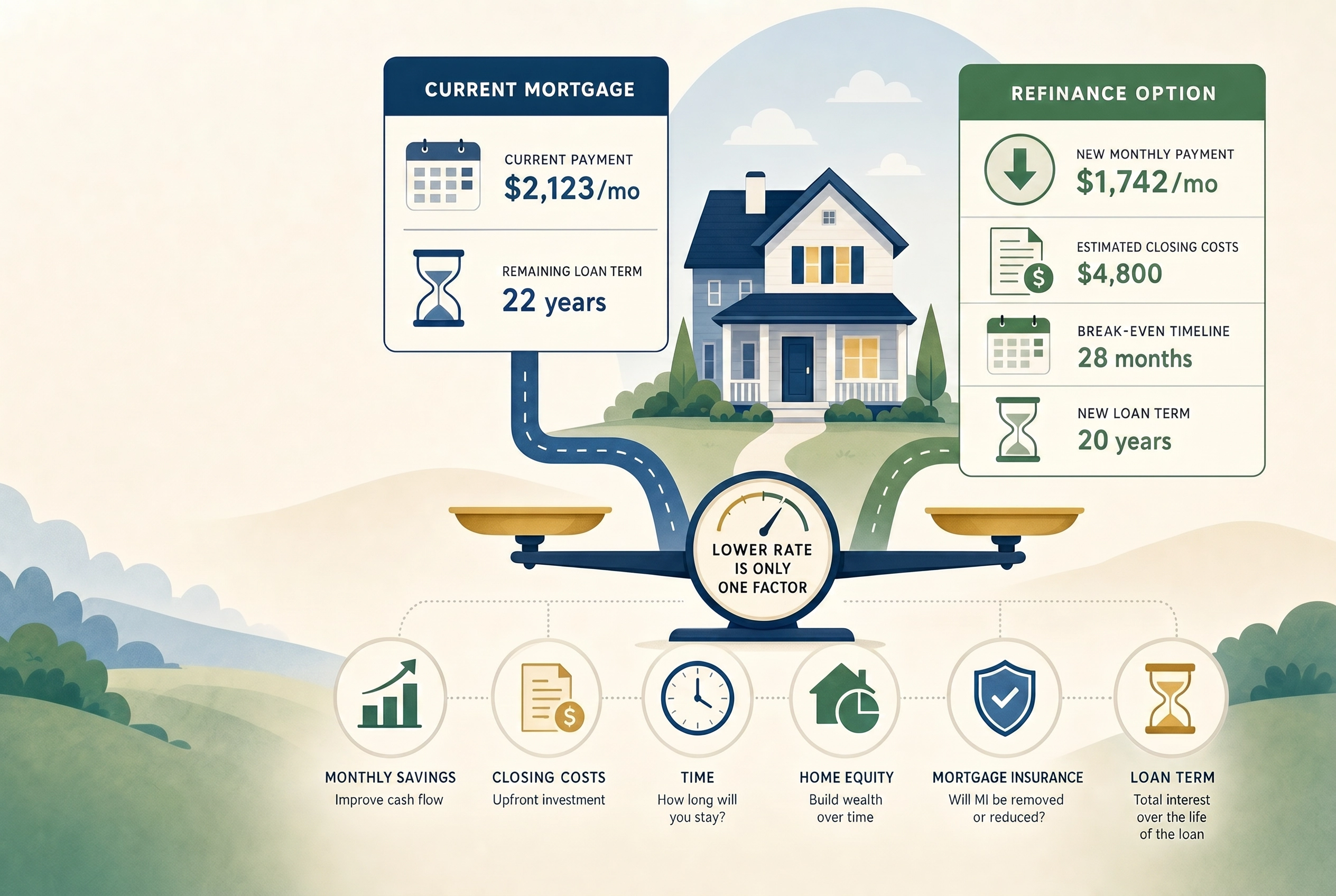
When comparing your current loan with a refinance, it helps to look at the current principal and interest payment, new payment, closing costs, break-even point, remaining loan term, new loan term, and how long you expect to stay in the home. That gives you a much clearer picture than comparing interest rates alone.
A Refinance Can Make Sense Without a Big Rate Drop
You do not always need a large rate reduction for a refinance to be worthwhile.
Your credit may have improved since you bought the home, which could help you qualify for better pricing. You may also be able to remove mortgage insurance or move into a loan structure that fits your current situation better.
In some cases, the value comes from several changes working together. A modest rate reduction combined with mortgage insurance savings can still create a meaningful improvement in the monthly payment.
That is why I prefer running the actual numbers instead of relying on a general rule about how far rates need to fall.
Removing Mortgage Insurance Can Change the Math
Mortgage insurance can be a large part of the refinance decision.
If you bought your home with a smaller down payment, you may have built equity through regular payments, extra principal payments, rising home values, or a combination of all three. Depending on your current loan and the new loan structure, refinancing may allow you to remove monthly mortgage insurance.
This part deserves a careful review. You do not always need to refinance to remove PMI on a conventional loan. Federal rules give many qualifying conventional loans the right to cancel or automatically terminate PMI under certain conditions.
Before assuming a refinance is required, review your current loan. Either way, compare your total current payment with the total proposed payment.
Be Careful With “No Closing Cost” Refinances
You will sometimes see refinances advertised as having no closing costs. That does not always mean there is truly no cost involved.
A no-closing-cost refinance may use a higher interest rate with lender credits, or some allowable costs may be added to the loan balance.
Both structures can make sense depending on the situation. A lender credit may work well for someone who wants to refinance without paying a large amount upfront. Rolling costs into the loan can also be useful in some cases.
The important part is understanding how the costs are being paid.
If you expect to keep the loan for only a few years, a lower-upfront-cost option with a higher rate may make sense. If you expect to keep the loan for a long time, paying more upfront for better pricing may save more over time.
Cash-Out Refinancing Is a Different Decision
A cash-out refinance replaces your current mortgage with a larger loan and allows you to access some of your home equity.
Homeowners use cash-out funds for many purposes. These may include paying off higher-interest debt, making home improvements, covering major expenses, handling business needs, or reaching other financial goals.
This type of refinance deserves extra review.
Paying off a credit card with mortgage proceeds may lower the interest rate and required monthly payment on that debt. However, the debt is now secured by the home and may be repaid over a much longer period. The monthly payment may look better while the long-term cost tells a different story.
I like to compare the current debts, monthly payments, interest rates, expected payoff periods, and the new mortgage structure before deciding whether a cash-out refinance makes sense.
Refinancing to Shorten the Loan Term
Not every refinance is about lowering the monthly payment.
Some homeowners refinance to shorten the loan term. For example, someone may move from a 30-year loan to a 15-year loan. The payment may stay similar or increase, but the loan is paid off sooner.
This can work well for someone with stable income who wants to reduce long-term interest costs and enter retirement with less debt. It can also reduce monthly flexibility, so the borrower needs to be comfortable with the required payment, not only the long-term savings.
Another option is to keep the current loan and make extra principal payments. This does not provide a lower interest rate or required payment, but it avoids refinance costs.
Both strategies are worth comparing.
Who Should Consider a Refinance Review?
A refinance review may be worth considering if:
- Your current rate is higher than available options
- Your credit has improved
- Your home equity has grown
- You are paying mortgage insurance
- You want a shorter loan term
- You want to consolidate higher-cost debt
- You need to restructure a HELOC or second mortgage
- Your financial goals have changed
Reviewing the numbers does not mean you have to refinance. Sometimes keeping your current mortgage is the better decision. A good refinance review should show both options clearly.
Compare the Whole Transaction
A refinance should solve a real problem or clearly improve your financial position.
I look at the monthly savings, closing costs, break-even point, new loan term, and how long you plan to stay in the home. For cash-out refinances, I also look at how the money will be used and what debts or expenses the new mortgage is replacing.
There is no single rate drop that makes every refinance worthwhile.
At Capital City Mortgage, we can compare your current mortgage with available refinance options and lay the numbers out side by side. Sometimes refinancing makes sense. Sometimes keeping your current loan is the better answer.
The goal is knowing the difference before you decide.
How much should mortgage rates drop before I refinance?
There is no set rate drop that works for every homeowner. The decision should be based on the monthly savings, refinance costs, break-even point, remaining loan term, and how long you expect to keep the new mortgage.
How do I calculate the break-even point on a refinance?
A simple method is to divide the refinance costs by the monthly savings. For example, if the refinance costs $4,500 and saves $175 per month, the simple break-even point is about 26 months.
Does refinancing restart my mortgage at 30 years?
Only if you choose a new 30-year term. Refinance loans may have different term options. It is important to compare the remaining term on your current mortgage with the term of the proposed new loan.
Is a no-closing-cost refinance really free?
Not necessarily. The costs may be covered through a higher interest rate and lender credit, or allowable costs may be added to the new loan balance. The structure should be compared with other rate and cost options.