
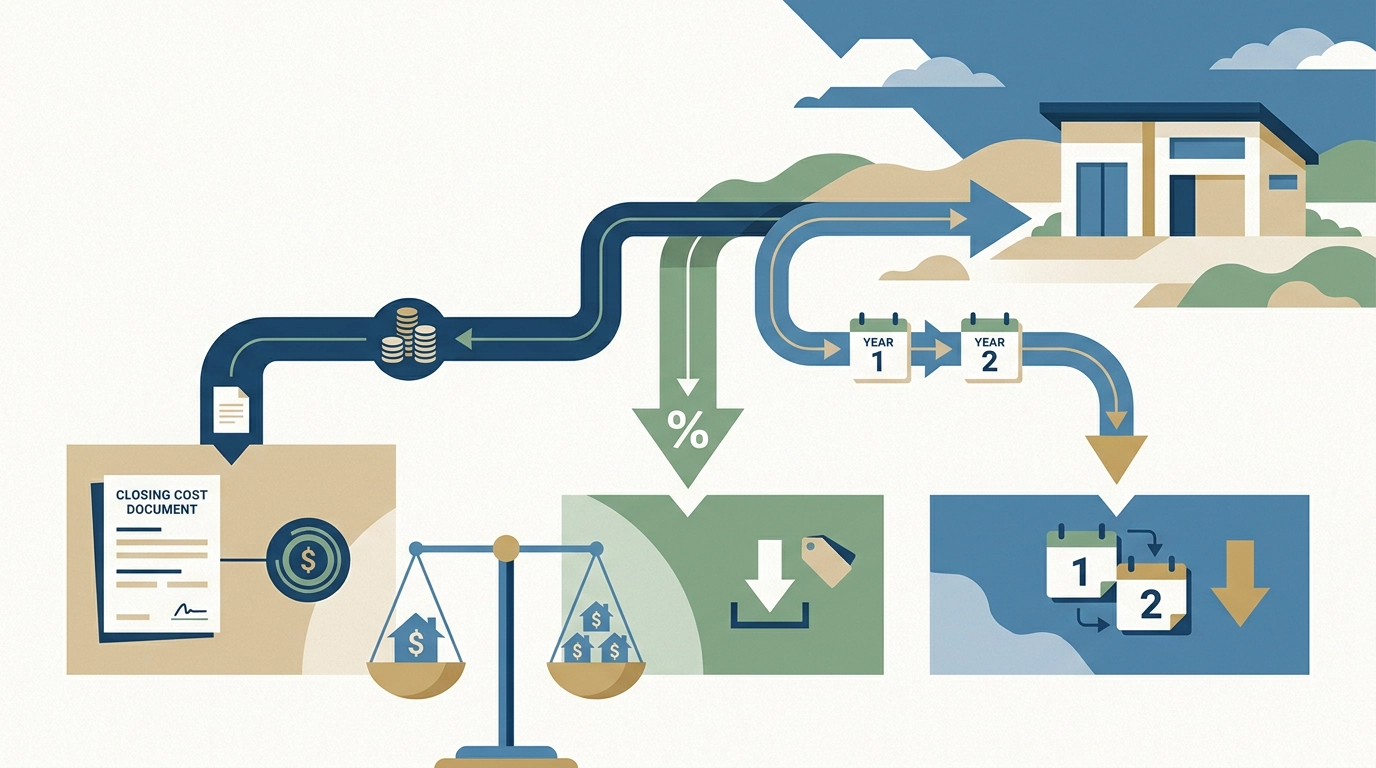
When a seller agrees to provide money toward a buyer’s closing costs, the credit can create several options. You may be able to reduce the amount you bring to closing, pay discount points for a permanently lower mortgage rate, or fund a temporary rate buydown.
The best choice is not always the option with the lowest initial payment. Buyers should compare the upfront benefit, long-term savings, break-even point, and how long they expect to keep the mortgage.
What Is a Seller Credit?
A seller credit is an amount the seller agrees to pay toward eligible buyer expenses. It is normally written into the purchase agreement as a dollar amount or percentage of the purchase price.
Depending on the loan program and transaction, seller credits may be used for closing costs, prepaid property taxes, homeowners insurance, discount points, and certain rate buydowns. Under standard Fannie Mae conventional guidelines, seller contributions cannot be used for the buyer’s down payment, minimum required contribution, or financial reserve requirement.
The maximum credit depends on the loan program, occupancy type, down payment, and other details. Conventional, FHA, VA, and USDA loans do not all use the same limits. FHA generally allows interested parties to contribute up to 6% of the sales price toward eligible costs, while VA has separate rules for seller concessions.
This is why the amount of the seller credit should be reviewed with your loan officer before the offer is finalized.
Option 1: Use the Credit to Reduce Cash at Closing
The simplest option is to apply the seller credit toward normal closing costs and prepaid expenses. This may include lender charges, title expenses, appraisal costs, homeowners insurance, prepaid interest, and money placed into the escrow account.
This strategy is often helpful for buyers who have enough money for the down payment but want to preserve some of their savings. Keeping additional money available after closing can help with moving expenses, repairs, furniture, and unexpected homeownership costs.
Reducing your cash to close may be more valuable than lowering the payment by a small amount. This is especially true when using more of your savings would leave you with little money after the purchase.
Seller credits generally cannot exceed the eligible costs available on the transaction. Under Fannie Mae guidelines, financing concessions must be no greater than the borrower’s allowable closing costs. An amount above the permitted costs may be treated as a sales concession and affect the transaction.
Option 2: Use the Credit for a Permanent Rate Buydown
A permanent rate buydown uses discount points to obtain a lower interest rate for the life of the mortgage. The lower rate remains in place unless the home is sold, the loan is refinanced, or the mortgage is otherwise paid off.
One mortgage point equals 1% of the loan amount. On a $300,000 mortgage, one point would cost $3,000. However, one point does not always reduce the interest rate by the same amount. The rate improvement depends on the lender, loan program, borrower qualifications, and current mortgage market.
A permanent buydown can make sense when you expect to keep the loan long enough to recover the upfront cost through monthly savings. It may be less valuable when you expect to move or refinance within a few years.
The seller is paying the cost in this situation, but the credit still has value. You should compare the permanent buydown against other ways the same seller credit could be used.
Option 3: Use the Credit for a Temporary Buydown
A temporary buydown reduces the buyer’s required payment during the first one, two, or three years of the mortgage. A common example is a 2-1 buydown.
With a 2-1 buydown, the first-year payment is calculated as though the interest rate were two percentage points below the note rate. The second-year payment is calculated as though the rate were one percentage point lower. The borrower begins making the full payment based on the actual note rate in the third year.
The mortgage rate written into the note does not change. Money is placed into a separate account and used to cover the difference between the reduced payment and the full payment. Fannie Mae requires borrowers with an eligible temporary buydown to qualify using the full note-rate payment, not the temporarily reduced payment.
A temporary buydown can provide useful breathing room during the first years of homeownership. It may help when buyers expect their income to increase, are paying for moving expenses, or want additional flexibility while settling into the home.
The payment increase still needs to be planned for. Buyers should be comfortable with the full payment before choosing this option. Refinancing later may be possible, but a refinance should never be treated as guaranteed.
How to Compare the Three Options
The right use of a seller credit depends on your finances and plans for the property. Start by comparing the following:
- The total cash required at closing.
- The monthly payment during each year.
- The cost of obtaining the lower rate.
- The break-even period for a permanent buydown.
- The amount of savings you will have after closing.
- How long you expect to keep the mortgage.
For a permanent buydown, divide the cost of the discount points by the monthly payment savings. This gives you a basic break-even period.
Suppose a $3,000 buydown reduces the principal and interest payment by $65 per month. The break-even period would be approximately 46 months.
$3,000 ÷ $65 = 46.15 months
In this example, the borrower would need to keep the mortgage for almost four years before the monthly savings recover the cost. The calculation should be based on actual loan options because mortgage pricing can change daily.
A Practical Seller Credit Example
Assume a buyer negotiates a $7,500 seller credit. The buyer has $5,000 in normal closing costs and prepaid expenses.
One option is to use $5,000 toward those costs and apply the remaining $2,500 toward a permanent rate buydown. Another option is to use part of the credit for a temporary buydown. The exact structure would depend on the mortgage pricing, loan program, and available eligible costs.
The buyer should not assume that any unused amount will be returned as cash. Seller credits normally must be applied to permitted transaction expenses. Reviewing the estimate before finalizing the offer can help prevent part of the negotiated credit from going unused.
Who May Benefit Most From a Rate Buydown?
A permanent buydown may be most useful for a buyer who expects to stay in the home and keep the mortgage for several years. It can also work well when the buyer already has strong savings and does not need the seller credit to reduce cash at closing.
A temporary buydown may be more useful for someone who wants lower payments during the first few years but can comfortably afford the eventual full payment. It can provide short-term flexibility, but it does not create permanent interest savings.
Using the credit for closing costs may be the strongest choice for a buyer who wants to preserve savings. Having cash available after closing can sometimes provide more financial security than receiving a slightly lower monthly payment.
Look at the Entire Loan, Not Only the Rate
A seller credit is a valuable part of an offer, but it should be used with a clear purpose. The lowest first-year payment, lowest interest rate, and lowest cash to close are three different goals.
At Capital City Mortgage, we can compare the available choices side by side. We will show you the upfront cost, monthly payment, break-even period, and long-term interest impact so you can decide how the credit should be used.
We work with multiple lenders and loan programs for buyers throughout Nebraska. That allows us to compare more than one rate and cost structure instead of assuming one option is right for every buyer.
Frequently Asked Questions
Can seller credits be used for the down payment?
Seller credits generally cannot be used for the buyer’s required down payment. They are commonly applied toward allowable closing costs, prepaid expenses, discount points, and approved rate buydowns. Exact rules depend on the loan program and transaction.
Is a permanent buydown better than a temporary buydown?
A permanent buydown may be better when the buyer expects to keep the mortgage long enough to recover the upfront cost. A temporary buydown may be better when the buyer values lower payments during the first few years. The best choice depends on the buyer’s savings, budget, and expected time in the loan.
Does a temporary buydown help a buyer qualify for a larger loan?
A temporary buydown usually does not allow the buyer to qualify using the reduced introductory payment. Many mortgage programs require qualification using the full payment based on the note rate. Program and lender requirements should be confirmed before relying on a buydown structure.
What happens if the full seller credit is not used?
An unused seller credit generally is not given to the buyer as cash. The credit normally must be applied toward eligible transaction expenses and may be limited by the buyer’s actual costs. The purchase agreement may sometimes be amended before closing, subject to approval from the parties and the lender.