
A new-construction home may have a surprisingly small property-tax bill during the first year. That does not mean the taxes will stay at that amount.
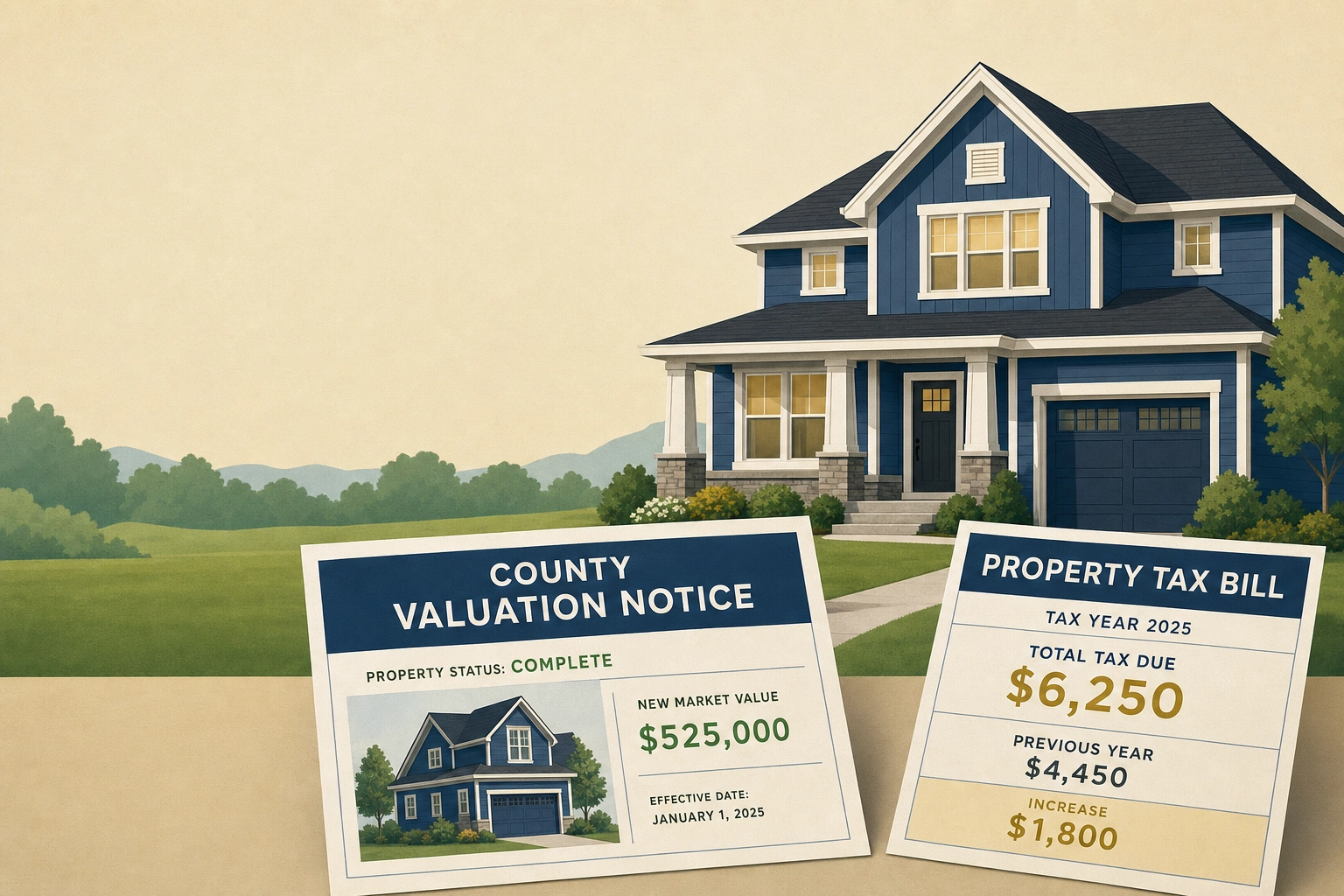
The current county record may reflect an empty lot, a partially completed house, or a value established before construction was finished. Once the county adds the completed home to its records, the assessed value and property-tax bill may increase substantially.
This can also affect the monthly mortgage payment. Even with a fixed interest rate, the total payment may rise when the amount collected for property taxes changes.
When the County Updates the Property Value
For a new-construction home, the current county value may reflect only the land or a partially completed house. Once the county adds the completed home to its records, the assessed value may increase substantially.
Nebraska county assessors must generally notify property owners of an increase or decrease in valuation by June 1. Lancaster County lists the important property-assessment dates.
Receiving the valuation notice does not mean the higher taxes are due immediately. The updated tax bill may not become payable until a later tax cycle. This delay is why some homeowners live in a completed house for months before seeing the full property-tax increase.
The timing can vary based on the property, construction completion, and county assessment process. Buyers should contact the county assessor for information about a specific home.
Why the Current Tax Bill Can Be Misleading
Online property records are useful, but they often look backward. The latest available tax bill may have been based on a value established before the house existed.
Assume a builder owns a lot assessed at $75,000. A buyer later purchases a completed home on that lot for $450,000. The current tax record might still show taxes based mainly on the $75,000 land value.
Using a hypothetical tax rate of 2%, taxes on a $75,000 value would be approximately $1,500 per year. Taxes on a $450,000 value would be approximately $9,000 per year. That is a difference of $7,500 annually, or $625 per month.
This is only an illustration. The eventual assessed value does not have to equal the purchase price, and the total tax rate depends on the property’s location and taxing districts. School districts, cities, counties, natural-resource districts, and other local entities can all affect the final bill.
Nebraska Property Taxes Are Paid Later
The timing of Nebraska property taxes adds another layer of confusion. The county may update the property’s value months before the homeowner must pay the higher tax bill.
In Douglas, Lancaster, and Sarpy counties, the first half of the property taxes becomes delinquent April 1 and the second half becomes delinquent August 1 if unpaid. Other Nebraska counties generally use May 1 and September 1. The Nebraska Department of Revenue explains the statewide property-tax schedule.
This delay can make the lower tax amount appear to last longer than expected. A buyer may close on a completed home while the county is still collecting taxes based on an earlier land-only or partial assessment.
The higher bill may not arrive until a later tax cycle. By then, the homeowner may have lived in the property for many months.
How New Construction Taxes Affect Escrow
Many homeowners pay property taxes through an escrow account. Part of each monthly mortgage payment is deposited into the account, and the loan servicer uses that money to pay the tax bill when it is due.
For unassessed new construction, federal escrow rules allow a servicer to estimate taxes using comparable residential properties in the area. The CFPB’s Regulation X escrow rule addresses estimates for unassessed new construction.
However, the estimate shown during the loan process may not match the exact bill eventually issued by the county. The completed assessment and future tax levies are not always known at closing.
If the escrow account was funded using the lower tax amount, it may not contain enough money when the larger bill becomes due. This creates an escrow shortage.
Why the Mortgage Payment May Increase
A fixed-rate mortgage keeps the principal and interest portion of the payment fixed. It does not freeze property taxes or homeowners insurance.
When the servicer completes an escrow analysis, it reviews the expected tax and insurance bills against the money available in the account. If the anticipated bills increase, the regular monthly escrow deposit will increase too.
The payment can rise for two reasons at once. The homeowner must begin saving enough for the new annual tax amount, and the servicer may also collect additional money to repay an existing shortage.
For example, taxes increasing by $6,000 per year would add about $500 per month to the ongoing escrow need. If the account also has a $3,000 shortage that is repaid over 12 months, that could add another $250 per month during the repayment period. In this simplified example, the total payment could temporarily rise by approximately $750 per month.
Federal rules provide several methods for handling escrow shortages, depending on the shortage amount and account status. The CFPB explains how servicers may collect an escrow shortage.
How Buyers Can Prepare for the Higher Taxes
Start by confirming what the current assessed value includes. The county property record may identify the land value, improvement value, construction status, and most recent valuation.
Next, estimate taxes using a realistic completed-home value. The purchase price or appraisal can provide a starting point, but neither guarantees the county’s final assessment. Apply the approximate tax rate for the actual property location rather than using a general statewide percentage.
Review nearby completed homes in the same subdivision when possible. A similar home that has already received a full assessment may provide a more useful estimate than the vacant lot’s current bill.
It can also help to save the difference between the temporary payment and the projected payment. If the mortgage payment includes $150 per month for taxes but the completed-home estimate is $700, setting aside the $550 difference can build a cushion before the adjustment arrives.
Pros and Cons of an Escrow Account
An escrow account spreads large tax and insurance bills across monthly payments. It can make budgeting easier and reduce the risk of forgetting a tax deadline.
The limitation is that escrow is only a collection method. It does not prevent taxes or insurance premiums from increasing. If the original estimate is low, the payment can still change after the annual analysis.
A homeowner without escrow has more direct control over the money but must be prepared to pay the county when taxes are due. The household should save consistently because the larger completed-home bill may arrive well after closing.
Who Is This Most Relevant For?
This issue is most relevant for buyers purchasing a newly completed home when the county record still reflects vacant land or construction in progress. It also applies to buyers building on land they already own and homeowners completing a major addition.
The risk is greater when the current tax amount is much lower than taxes on comparable completed properties. Buyers with tight monthly budgets should review the future estimate carefully before deciding what payment is comfortable.
Budget for the Completed Home
The current tax bill is not always the best number for planning a new-construction purchase. A realistic budget should reflect the likely taxes on the completed property, even if those taxes will not be billed immediately.
At Capital City Mortgage, we work to provide Nebraska buyers with practical estimates for property taxes, homeowners insurance, and the total mortgage payment. We also explain when a new-construction estimate is based on land value, a partial assessment, or a projected completed value.
No estimate can guarantee the county’s future valuation or tax levy. The goal is to avoid building a home budget around a temporary tax bill that is unlikely to last.
Frequently Asked Questions
Why are property taxes low on a new construction home?
The current county value may reflect only the land or a partially completed house. Once the completed home is added to the county’s records, the assessed value and property-tax bill may increase.
When will my new construction property taxes increase?
The county may update the assessed value after adding the completed home to its records. Property owners must generally receive notice of a valuation increase or decrease by June 1, but the higher taxes may not become payable until a later tax cycle.
Can my payment increase with a fixed-rate mortgage?
Yes. The principal and interest payment stays fixed, but the total payment can change when property taxes, homeowners insurance, or the amount needed for escrow changes.
How can I estimate taxes on a new home?
Review the purchase price, appraisal, local tax rate, and assessments of similar completed homes. The county assessor can explain the current property record, but the final future value and tax bill cannot be guaranteed.