
Being self-employed does not prevent you from buying a house. Business owners, independent contractors, freelancers, and partners qualify for mortgages every day.
The difference is how income is documented and calculated. A salaried employee may qualify using a current pay rate. A self-employed buyer is commonly evaluated using tax returns, business performance, income history, and the likelihood that the income will continue.
Starting the review before making an offer gives you time to gather documents and identify the loan program that fits your situation.
Who Is Considered Self-Employed?
For many conventional mortgages, a borrower is generally treated as self-employed when the borrower owns 25% or more of a business. This can include a sole proprietorship, partnership, limited liability company, S corporation, or regular corporation.
Receiving a Form 1099 does not always mean the mortgage lender will complete a full self-employment analysis. The lender reviews how the income is earned, whether the borrower owns a business, and whether business expenses must be deducted.
A borrower can also be both employed and self-employed. Someone may receive W-2 wages from a company while owning a separate business. Each income source is evaluated under the guidelines that apply to it.
How Long Must You Be Self-Employed?
A two-year history is the common standard. Fannie Mae generally requires lenders to review two years of prior earnings to determine whether the income is stable and likely to continue. You can review its current self-employed borrower documentation requirements.
A shorter history may be acceptable in some situations. For example, a borrower who has been self-employed for at least twelve months and previously worked in the same or a similar field may qualify when the file contains strong supporting factors.
A one-year history is not automatically acceptable. The mortgage program, prior employment, business structure, income trend, credit, reserves, and automated underwriting results all matter.
If the business is new and the borrower has no related experience, waiting may be necessary. Underwriters need enough information to determine that the income is established and likely to continue.
What Documents Will the Lender Need?
Documentation varies by business type, ownership percentage, loan program, and automated underwriting findings. A self-employed buyer may be asked to provide:
- Personal federal income-tax returns
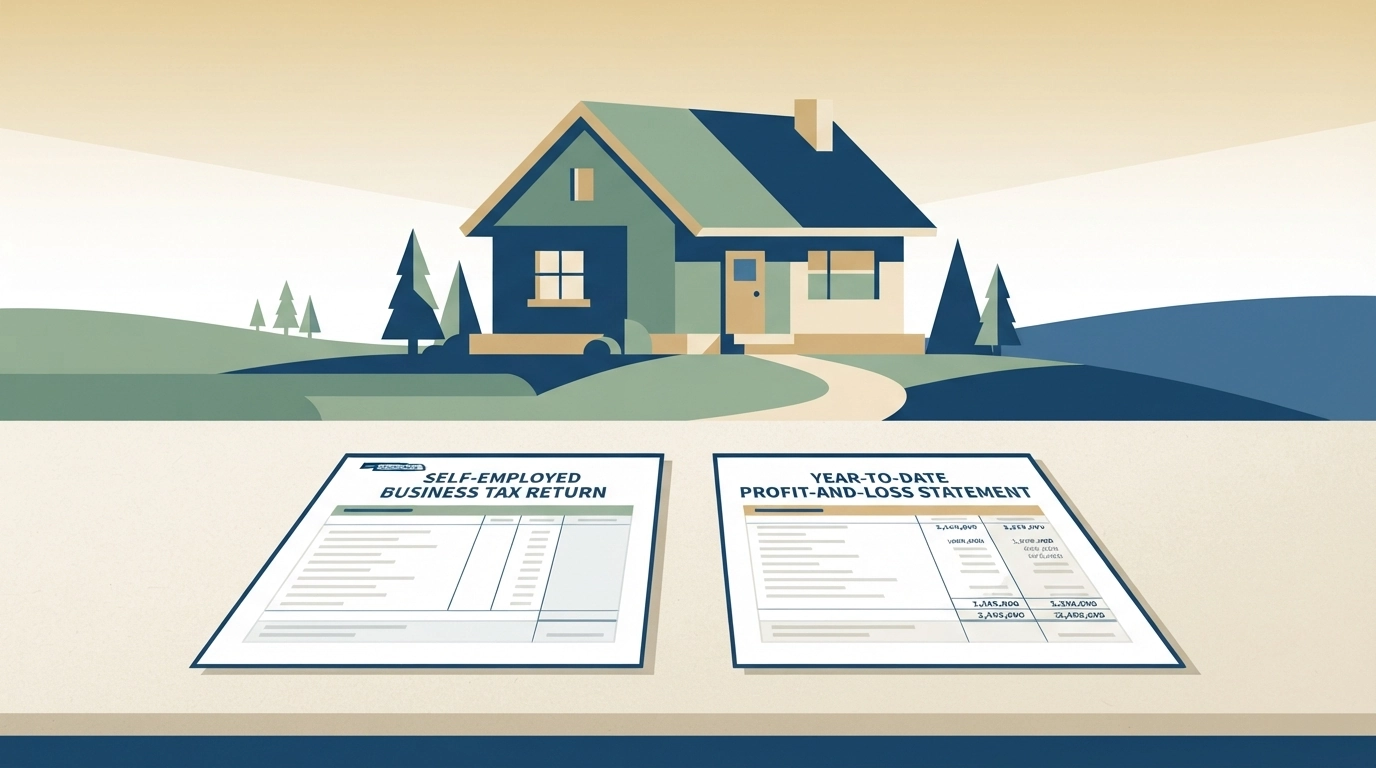
- Business tax returns
- Year-to-date profit-and-loss statement
- Current business balance sheet
- Forms 1099 or Schedule K-1
- Business bank statements
- Proof that the business is active
- Documentation of ownership
- A business license when applicable
The lender may also obtain IRS tax-return transcripts. Additional documents may be needed when income has changed significantly, the business recently reorganized, or money from the business will be used for the down payment or closing costs.
FHA maintains its self-employed income requirements in the Single Family Housing Policy Handbook. Conventional, FHA, VA, USDA, jumbo, and non-qualified mortgages can have different documentation standards.
Is Gross Revenue Used for Mortgage Qualification?
Lenders usually do not qualify a business owner based only on gross revenue. Revenue is the money received before business expenses. Qualifying income is more closely connected to the net income remaining after expenses and applicable adjustments.
Assume a business receives $180,000 during the year but reports $110,000 of ordinary and necessary expenses. The lender will not normally treat the entire $180,000 as the owner’s personal qualifying income.
Certain noncash expenses may be added back under mortgage guidelines. Depreciation, depletion, business use of a home, and some one-time expenses may receive different treatment depending on how they appear on the tax returns.
The final calculation can also depend on ownership percentage and whether the business has enough cash flow to support the income being used.
How Is Self-Employment Income Averaged?
A lender often averages income over the applicable review period. If income is stable or increasing, a two-year average may provide a reasonable estimate of monthly earnings.
For example, assume qualifying income was $72,000 in one year and $84,000 the next. The two-year average would be $78,000 annually, or $6,500 per month.
The calculation is not always that simple. If income declined from $84,000 to $60,000, the lender may use the lower amount or determine that the income is not stable enough to use without further explanation.
A strong current year does not always allow the lender to ignore lower prior earnings. Year-to-date results are normally reviewed with the tax-return history rather than used by themselves.
What if Your Income Declined?
Declining income does not automatically result in denial, but it requires careful review. The underwriter may ask why the income decreased and whether the cause has been resolved.
A temporary decline caused by a one-time equipment purchase may be viewed differently from a loss of major customers or an ongoing reduction in revenue. The lender may request current financial statements, business bank statements, contracts, or an explanation from the borrower.
The income used must be supported by the complete history. If the current year continues to decline, the prior average may overstate what the business is now producing.
Self-employed buyers should review their numbers before shopping for homes. A verbal estimate based on gross sales can create a very different result from the completed underwriting calculation.
Do Business Tax Deductions Hurt Mortgage Qualification?
Tax deductions can lower taxable income, which may reduce income taxes. They can also reduce the income available for mortgage qualification.
Not every deduction lowers qualifying income dollar for dollar. Some noncash expenses may be added back. Other expenses represent actual business costs and must remain in the calculation.
This is why adjusted gross income on a personal tax return does not always provide the complete answer. The lender may need to review Schedule C, Schedule E, Schedule F, Form 1065, Form 1120S, Form 1120, and related schedules.
Do not amend tax returns or stop taking legitimate business deductions only to qualify for a mortgage without speaking with a qualified tax professional. Instead, have the mortgage income reviewed early so you understand the effect of the existing returns.
Can Business Funds Be Used to Buy the House?
Business funds may be available for a down payment, closing costs, or reserves, but the withdrawal cannot harm the business.
The lender may review business tax returns, financial statements, and bank statements to determine whether removing the money will weaken cash flow. A large withdrawal from an operating account may create concern when the business needs those funds for payroll, inventory, taxes, or normal expenses.
Transferring money between accounts also creates a documentation trail. Talk with the mortgage professional before moving funds so the source and transfer can be documented correctly.
What if Tax Returns Do Not Show Enough Income?
Some self-employed borrowers have strong cash flow but do not qualify for a standard mortgage using tax-return income. A bank-statement loan or another non-qualified mortgage may be an option.
A bank-statement program may evaluate deposits over a set period and apply an expense factor instead of relying entirely on traditional tax-return income. These loans can have higher rates, larger down-payment requirements, reserve requirements, and different credit standards.
A non-qualified mortgage should be compared with conventional and government options. The easier income calculation may come with a higher overall cost.
It may also be possible to improve traditional qualification by reducing monthly debt, making a larger down payment, or waiting until another year of income is documented.
Pros and Cons of Applying as a Self-Employed Buyer
Self-employment can provide income growth, control, and several sources of revenue. A well-established business with organized records can create a strong mortgage application.
The disadvantage is that income analysis takes more time and documentation. Business deductions, declining earnings, uneven deposits, recent ownership changes, and large business withdrawals can affect qualification.
Self-employed buyers should avoid major business changes during the mortgage process when possible. Adding a partner, changing the business structure, taking on new debt, or making a large asset purchase may require additional review.
Who Should Begin the Review Early?
An early review is especially important for buyers who recently became self-employed, own multiple businesses, receive partnership income, or had a large change in earnings. It also helps buyers planning to use business funds for closing.
Borrowers with amended returns, tax extensions, cryptocurrency income, seasonal earnings, or complicated ownership structures should allow additional time. The same applies when the business recently changed from a sole proprietorship to an LLC, partnership, or corporation.
Prepare the Income Before Making an Offer
You can buy a house while self-employed, but the lender must calculate stable, documented income that meets the selected program’s requirements. Gross sales, bank balances, and personal estimates are not enough by themselves.
At Capital City Mortgage, we review self-employed income before Nebraska buyers begin making offers. We compare conventional, FHA, VA, USDA, jumbo, and alternative-documentation options through multiple lenders. A careful preapproval can identify documentation needs early and reduce surprises after a purchase agreement is signed.
Frequently Asked Questions
Can I get a mortgage with only one year of self-employment?
Possibly. Some programs may allow a shorter history when you have been self-employed for at least twelve months, previously worked in the same or a similar field, and meet the other underwriting requirements.
Do mortgage lenders use gross or net self-employment income?
Lenders generally begin with taxable business income after expenses and then apply permitted adjustments. Gross revenue alone is not normally used as the borrower’s qualifying income.
How many years of tax returns do self-employed borrowers need?
One or two years may be required depending on the loan program, length of self-employment, ownership, and automated underwriting results. Additional business documents may also be needed.
Can I use business bank statements instead of tax returns?
Certain bank-statement and non-qualified mortgage programs may allow this. These loans follow different underwriting rules and may have higher rates, larger down payments, or stronger reserve requirements.