
For many homebuyers, putting 20% down has always been presented as the goal.
There are good reasons for that advice. A larger down payment reduces the loan amount, lowers the monthly principal and interest payment, and can eliminate private mortgage insurance on a conventional loan.
But that does not mean 20% down is automatically the best financial decision for every homebuyer.
The real question is not simply, “How much can I put down?”
A better question is:
How much should I put down while still keeping enough money available for everything that comes after closing?
For many buyers, especially move-up buyers and first-time homeowners, keeping a healthy amount of savings after closing may be more valuable than putting every available dollar into the house.
You Do Not Always Need 20% Down to Buy a Home
One of the biggest mortgage misconceptions is that buyers need a 20% down payment.
Many loan programs allow significantly less. For example, Freddie Mac’s Home Possible program and certain other conventional options can allow down payments as low as 3% for eligible borrowers. FHA financing can allow a down payment as low as 3.5%. Eligibility, income limits, occupancy requirements, credit qualifications, and other guidelines vary by program.
Putting less than 20% down on a conventional loan will generally mean paying private mortgage insurance, commonly called PMI. PMI increases the monthly cost of the loan, but it also allows qualified buyers to purchase without waiting until they have accumulated a full 20% down payment.
The right decision depends on more than whether PMI is involved.
The Problem With Using All Your Available Cash
Imagine a buyer purchasing a $400,000 home.
A 20% down payment would be $80,000.
A 10% down payment would be $40,000.
The difference is $40,000.
The 20% down option would have a lower loan amount and monthly payment. The 10% down option would likely include PMI and a higher payment.
Looking only at the mortgage payment, putting 20% down appears to be the obvious choice.
But what happens if putting $80,000 down leaves the buyer with only $5,000 in savings?
That can create a different type of financial risk.
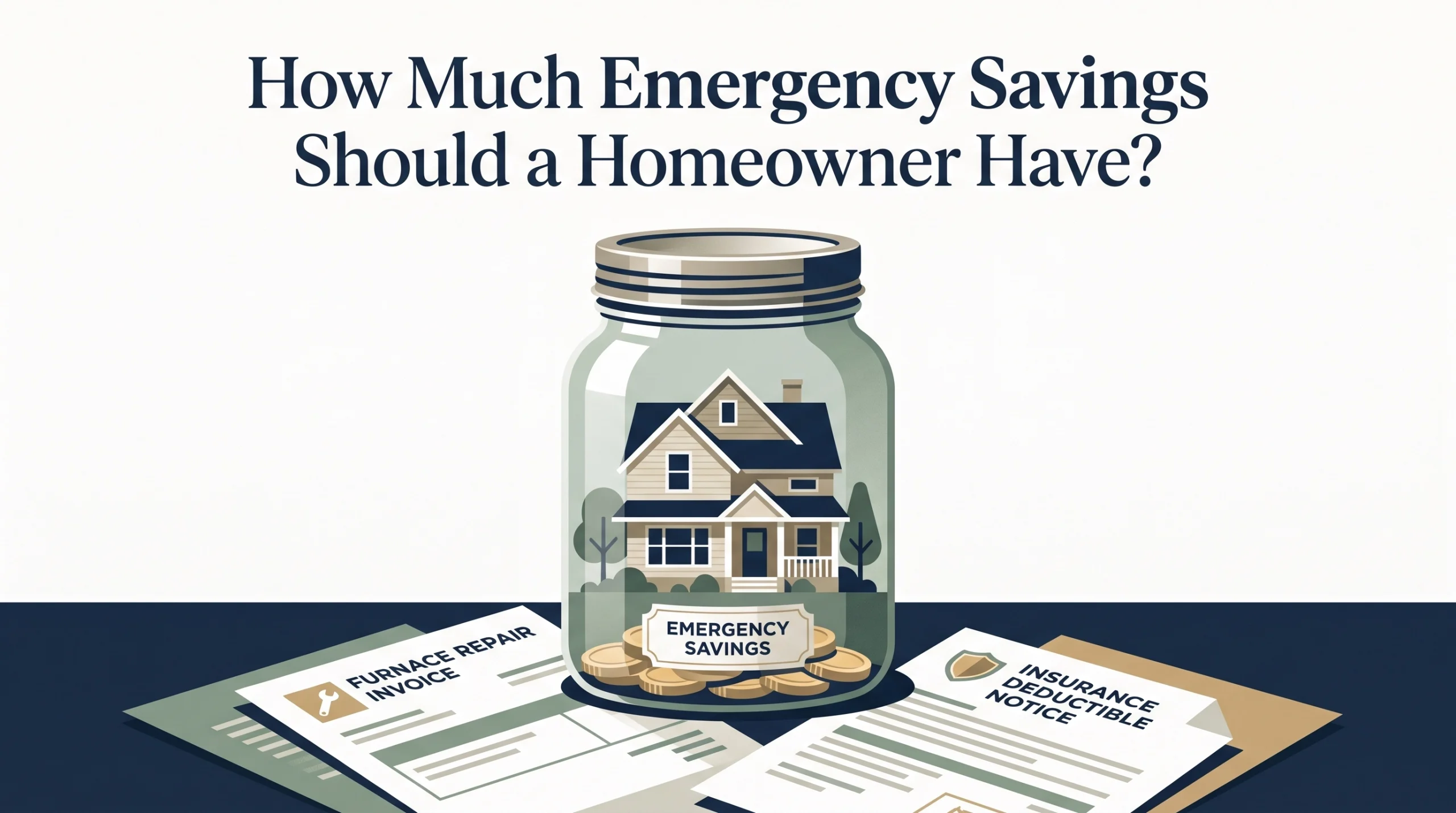
Homeownership comes with expenses that are difficult to predict. An HVAC system can fail. A roof can need repairs. Property taxes and insurance costs can change. A vehicle may need to be replaced. A family can experience an employment change or another unexpected expense.
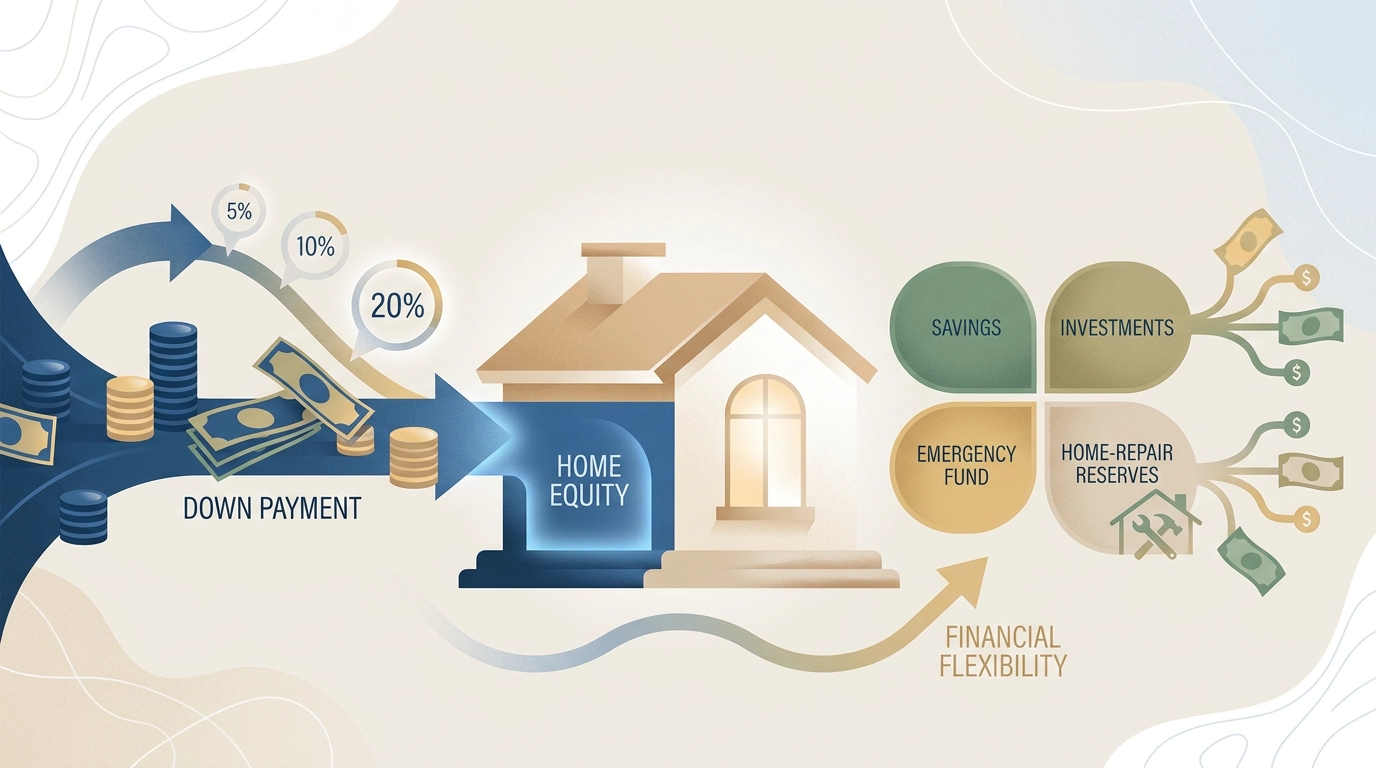
Money used for a down payment becomes home equity. That equity has value, but it is not the same as having cash readily available in a checking, savings, or investment account.
Accessing that equity later may require selling the home, obtaining a home equity loan or HELOC, or completing a cash-out refinance. Those options depend on qualification requirements and market conditions at the time.
That is why I generally like buyers to think beyond the closing date.
A Lower Down Payment Can Preserve Financial Flexibility
There is no universal rule for how much money a buyer should keep after closing. Every household has different income stability, monthly expenses, investment goals, family needs, and tolerance for risk.
However, the amount of money remaining after closing should be part of the mortgage discussion.
A buyer might decide that the additional monthly cost of putting less down is worthwhile if it allows them to maintain:
- A strong emergency fund
- Money for repairs or improvements
- Funds for furniture and moving expenses
- College savings
- Retirement or investment assets
- Cash reserves for a business
- Flexibility during a job or career transition
The goal is not to put the smallest amount down possible. The goal is to find a balance between the mortgage payment, the amount due at closing, and the buyer's overall financial position.
PMI Is a Cost, But It Should Be Evaluated in Context
PMI is often treated as something that should be avoided at all costs.
I do not think that is always the right way to analyze it.
PMI protects the lender, not the homeowner, and it does add to the cost of the mortgage. The Consumer Financial Protection Bureau explains that conventional borrowers putting less than 20% down will often be required to carry PMI.
But the better question is what the buyer receives in exchange for that cost.
Suppose a buyer can keep an additional $40,000 available by putting 10% down instead of 20%.
That $40,000 could provide years of emergency reserves. It could allow the buyer to complete necessary improvements without using credit cards. It could remain invested for long-term goals. It could also help a self-employed buyer maintain needed business liquidity.
In that situation, PMI should be compared against the financial benefit of retaining access to the money.
Also, PMI on many conventional loans is not necessarily permanent. Federal law provides cancellation and automatic termination rights for many qualifying conventional mortgages once certain requirements are met, although the exact rules and any additional servicer requirements should be reviewed for the specific loan.
The Largest Down Payment Does Not Always Create the Best Loan Strategy
There are situations where 20% or more down may make excellent sense.
For example, a larger down payment may be attractive when a buyer:
- Has significant liquid assets remaining after closing
- Wants the lowest practical monthly payment
- Wants to avoid PMI
- Is approaching retirement and prioritizes lower fixed expenses
- Has money in low-yield accounts with no other planned use
- Needs the lower payment for loan qualification purposes
There are also situations where putting less down may deserve serious consideration.
This may include a buyer who:
- Would significantly reduce emergency savings by putting 20% down
- Has substantial home repairs or improvements planned
- Has variable or self-employed income
- Is receiving proceeds from another home sale after purchasing
- Wants to preserve investments rather than liquidate them
- Has other important short- or long-term financial goals
The correct answer is rarely based on one rule of thumb.
Consider the Different Loan Programs Before Deciding
The down payment decision should also be made after comparing available loan options.
For eligible borrowers, HomeReady and Home Possible are examples of conventional programs designed to provide lower-down-payment opportunities. Home Possible allows down payments as low as 3% and flexible funding sources, while HomeReady is designed for eligible lower-income borrowers and may also provide flexible down payment options.
FHA financing can allow as little as 3.5% down for qualifying borrowers. However, FHA loans have their own mortgage insurance structure and should be compared against conventional financing based on the borrower's complete situation.
A buyer with strong credit may find that conventional financing with PMI is attractive. Another buyer may receive better overall terms with FHA financing. Some eligible buyers may have access to other specialized options.
This is why comparing only the interest rate is not enough.
The better comparison includes:
Cash needed at closing + total monthly payment + loan costs + mortgage insurance + money remaining after closing.
What About Putting More Money Down Later?
Some buyers know they will receive a large amount of money after purchasing.
A common example is someone who buys a new home before selling their current house.
Depending on the loan and servicer, one possible strategy is to purchase with a smaller down payment, sell the previous home, apply part of the proceeds toward the new mortgage principal, and then request a mortgage recast.
A recast is different from a refinance. With a recast, a large principal payment is made and the loan payment is recalculated based on the lower remaining balance while generally keeping the existing loan's interest rate and maturity date.
Not every loan or servicer allows recasting, and fees, minimum principal reductions, timing requirements, and mortgage insurance treatment can vary. It is important to verify the specific requirements before structuring the purchase around this strategy.
For the right buyer, however, this can create flexibility. They can purchase before the previous home sells without immediately committing all available liquid assets to the new purchase.
Who Should Consider a Lower Down Payment?
A lower down payment strategy may be worth reviewing for buyers who have enough resources to purchase but do not want to become cash-poor after closing.
It can also be useful for buyers whose assets are invested, business owners who need working capital, or move-up buyers who expect proceeds from a future home sale.
The key is to make the decision intentionally.
Putting less down simply to spend the remaining money may not improve a buyer's financial position.
Keeping additional funds for reserves, investments, business needs, future home improvements, or other planned financial goals is a different type of strategy.
The Best Down Payment Is the One That Fits the Whole Financial Picture
There is nothing wrong with putting 20% down. For many buyers, it is an excellent choice.
But it should be a decision, not an automatic rule.
Before deciding how much to put down, compare multiple scenarios. Look at the monthly payment, mortgage insurance, cash needed at closing, and how much money will remain available afterward.
At Capital City Mortgage, we help Nebraska homebuyers compare different loan and down payment strategies before choosing a structure. Our goal is to help you understand the tradeoffs so you can make a decision based on your complete financial situation, not a generic rule of thumb.
Do I have to put 20% down to buy a home?
No. Several mortgage programs allow qualified borrowers to purchase with significantly less than 20% down. Some conventional programs permit down payments as low as 3%, while FHA financing can allow as little as 3.5% down for eligible borrowers.
Is PMI always bad?
PMI is an added cost and protects the lender rather than the homeowner. However, it can allow a buyer to purchase with less than 20% down and preserve more cash for reserves or other financial priorities. Whether that tradeoff makes sense depends on the complete financial picture.
Can PMI be removed later?
For many conventional mortgages, borrowers have cancellation rights and PMI can eventually terminate when applicable requirements are met. The exact timing and process depend on the loan and circumstances, so borrowers should review the requirements with their mortgage servicer.
Is it better to make a bigger down payment or keep money invested?
There is no universal answer. The decision depends on the mortgage costs, expected investment returns, tax considerations, emergency reserves, risk tolerance, and other financial goals. Comparing several down payment options side by side can help determine the most appropriate strategy.