
One of the most common questions homeowners ask is why their mortgage payment increased when they have a fixed interest rate.
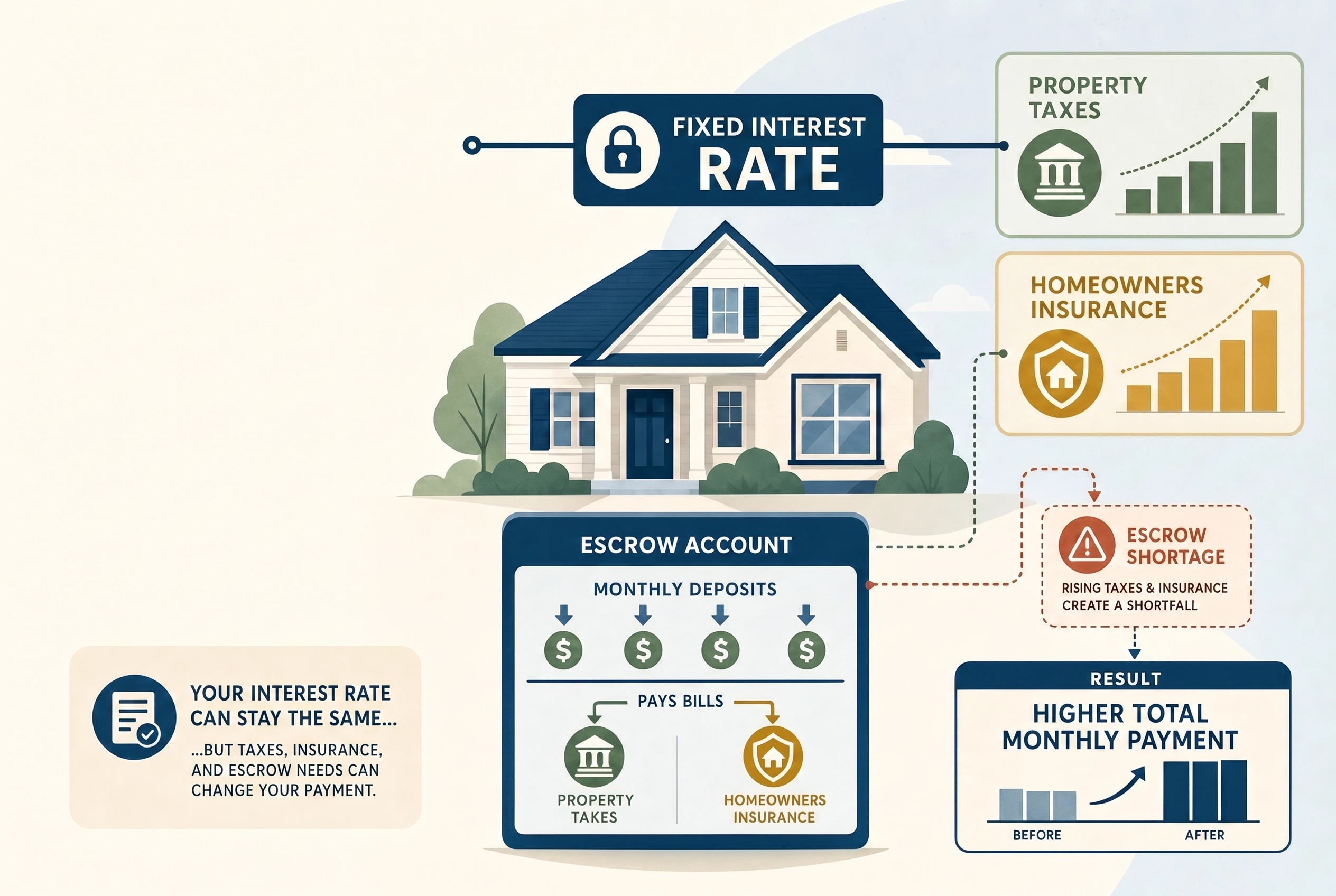
A fixed-rate mortgage means the interest rate on the loan does not change. It does not always mean the total monthly payment will stay exactly the same for the life of the loan.
For many homeowners, the monthly mortgage payment includes more than principal and interest. It may also include property taxes, homeowners insurance, and mortgage insurance. If one of those costs changes, the total payment can change even though the interest rate stays the same. The Consumer Financial Protection Bureau lists changes in property taxes and homeowners insurance as common reasons a monthly mortgage payment may increase.
Understanding the different parts of the payment makes these changes much easier to explain.
Your Fixed Rate Only Applies to Principal and Interest
A typical monthly housing payment may include several separate expenses. The principal portion reduces the loan balance. The interest portion is the cost of borrowing the money. A homeowner may also pay property taxes, homeowners insurance, and mortgage insurance as part of the monthly payment.
With a fixed-rate mortgage, the principal and interest payment is generally calculated based on the fixed interest rate and loan term. Property taxes and insurance are different. Those expenses can change over time.
For example, assume the principal and interest payment is $1,800 per month. The payment may also include $500 for property taxes and $200 for homeowners insurance. The total monthly payment would be $2,500.
If the insurance cost rises by $100 per month and the property tax amount rises by $75 per month, the total payment could increase to $2,675 even though the mortgage rate did not change.
How an Escrow Account Works
An escrow account is set up to help pay certain property-related expenses, most commonly property taxes and homeowners insurance. A portion of the monthly mortgage payment is deposited into the escrow account. The mortgage servicer then uses the money in that account to pay the bills when they come due.
This system can make budgeting easier because the homeowner pays part of those large expenses each month instead of paying the entire tax or insurance bill at once.
However, the servicer has to estimate how much money will be needed. When taxes or insurance premiums change, the amount collected each month may need to change as well.
Property Taxes Can Increase Your Payment
Property taxes are one reason an escrowed mortgage payment can change.
The mortgage servicer does not set the property tax amount. Taxes are determined by the applicable local taxing authorities. If the property tax bill changes, the escrow portion of the mortgage payment may also need to change so enough money is collected to pay the new amount.
This can sometimes surprise a homeowner after buying a house. The tax information available during the purchase may be based on previous assessments, exemptions, or other conditions that do not remain the same after ownership changes.
For Nebraska homeowners, the timing and effect of tax changes can depend on the property and local taxing authorities. The important point is that the mortgage servicer is collecting money for a separate bill. A fixed mortgage rate does not freeze the property tax amount.
Homeowners Insurance Can Also Change the Payment
Homeowners insurance is another common reason for a mortgage payment increase.
If the annual premium goes up, the mortgage servicer may need to collect more money each month through the escrow account. The CFPB specifically identifies homeowners insurance premium changes as a reason an escrowed mortgage payment may rise or fall.
For example, assume the annual insurance premium increases from $2,400 to $3,600. That is a $1,200 annual difference, or $100 per month before considering any existing escrow shortage.
This is why I encourage homeowners to review their insurance coverage and premium regularly. The mortgage company collects the payment, but the insurance policy and premium are still an important part of the homeowner's overall housing expense.
What Is an Escrow Shortage?
An escrow shortage can cause more confusion because the payment increase may be larger than the increase in the actual tax or insurance bill.
Assume the mortgage servicer estimated that $6,000 would be needed for taxes and insurance during the year. The actual cost ended up being $7,200.
The escrow account is now $1,200 short compared with the amount that was needed.
The servicer also knows that the next year may require about $7,200 again. The new payment may need to cover both the higher expected ongoing cost and repayment of the previous shortage.
That can create a payment increase that feels larger than expected.
Federal escrow rules govern how servicers analyze escrow accounts and handle shortages, surpluses, and payment adjustments.
Why the Increase Can Feel So Large
A homeowner may receive an escrow analysis showing that the monthly payment is increasing by $200 and assume the annual tax or insurance bill went up by $2,400.
That may not be the case.
Part of the increase could be the new amount needed for future bills. Another part could be repayment of an existing shortage.
For example, imagine taxes and insurance increased by a combined $1,200 per year. That accounts for $100 per month. If the escrow account also has a $1,200 shortage being repaid over 12 months, that adds another $100 per month.
The total payment increase could be $200 per month even though the ongoing cost increase was only $100 per month.
This is why it helps to read the escrow analysis instead of looking only at the new payment amount.
Can You Pay an Escrow Shortage Upfront?
Depending on the mortgage and servicer, a homeowner may be given options for handling an escrow shortage.
One option may be to repay the shortage through higher monthly payments. Another may be to pay some or all of the shortage separately.
The specific choices depend on the situation and servicing requirements, so the homeowner should review the escrow statement and contact the servicer with questions.
Paying the shortage upfront may lower the amount of the monthly increase, but it does not eliminate the higher ongoing tax or insurance cost. If the annual expenses have increased, the escrow collection will still need to reflect the new expected bills.
What Should You Review When Your Payment Changes?
When a mortgage payment increases, I would first compare the old and new payment breakdowns.
Look at the principal and interest amount. On a standard fixed-rate mortgage, this portion should generally remain based on the original fixed-rate loan terms.
Then look at the escrow section. Compare the property tax amount, insurance amount, and any shortage being collected.
Also review recent homeowners insurance renewal documents and property tax information. If something does not look correct, contact the mortgage servicer.
The CFPB recommends checking the mortgage statement when a payment changes and reviewing whether the change is related to the escrow portion of the payment.
What If You Do Not Have an Escrow Account?
Not every mortgage payment includes taxes and insurance.
If there is no escrow account, the homeowner is generally responsible for paying those expenses directly. In that case, the payment made to the mortgage servicer may stay the same while the homeowner's overall housing expenses still increase.
The CFPB explains that when taxes and insurance are not included in the mortgage payment, the homeowner pays those costs directly to the appropriate government authority and insurance company.
This is an important distinction. A stable mortgage payment does not necessarily mean the total cost of owning the home has stayed the same.
Plan for the Total Cost of Homeownership
A fixed-rate mortgage provides protection against changes to the interest rate on the loan. That is valuable, but homeowners still need to plan for property taxes, insurance, maintenance, and other ownership costs that may change over time.
When I work with homebuyers, I prefer to discuss the complete estimated payment instead of focusing only on principal and interest. I also like buyers to understand that the tax and insurance portions of the payment may change in future years.
If your mortgage payment has increased and you are not sure why, start with the payment breakdown and escrow analysis. In many cases, the change comes from taxes, insurance, an escrow shortage, or a combination of those items.
At Capital City Mortgage, we help Nebraska homebuyers understand the full mortgage payment before closing and remain available as a resource after the loan closes. A mortgage should make sense before closing, and homeowners should understand what is happening when the payment changes later.
Can my mortgage payment increase with a fixed interest rate?
Yes. The principal and interest portion of a standard fixed-rate mortgage is based on the fixed loan terms, but the total payment may include property taxes, homeowners insurance, and mortgage insurance. Changes to those expenses can change the total monthly payment.
What is an escrow shortage?
An escrow shortage happens when the escrow account does not have enough money to meet the required target based on expected property tax, insurance, and other permitted escrow expenses. The shortage may result in a higher payment while the shortage is being repaid.
Why did my payment increase more than my insurance premium increased?
Part of the increase may cover the higher future insurance or tax cost, while another part may be used to repay an existing escrow shortage. Reviewing the annual escrow analysis can help show how the new payment was calculated.
Will paying my escrow shortage lower my mortgage payment?
Paying an escrow shortage separately may reduce the portion of a payment increase caused by repayment of that shortage. It will not eliminate an increase caused by higher ongoing property taxes or insurance premiums.